The Wearables Worth Wearing (And the Ones That Are Just Hype)
Izak Tareb
September 19, 2026
Fitness wearables have evolved from glorified step counters into miniature health dashboards. A watch or ring can now estimate your heart rate, sleep duration, training load, blood oxygen levels, recovery, stress, calories burned, and dozens of other metrics before you have even finished breakfast.
That sounds incredibly useful.
Sometimes it is.
The problem is that wearables can measure some things reasonably well, estimate others imperfectly, and turn still others into beautifully designed numbers that appear more precise than they really are.
The best wearable is therefore not necessarily the device collecting the most data. It is the one that measures something useful and helps you make better decisions because of it.
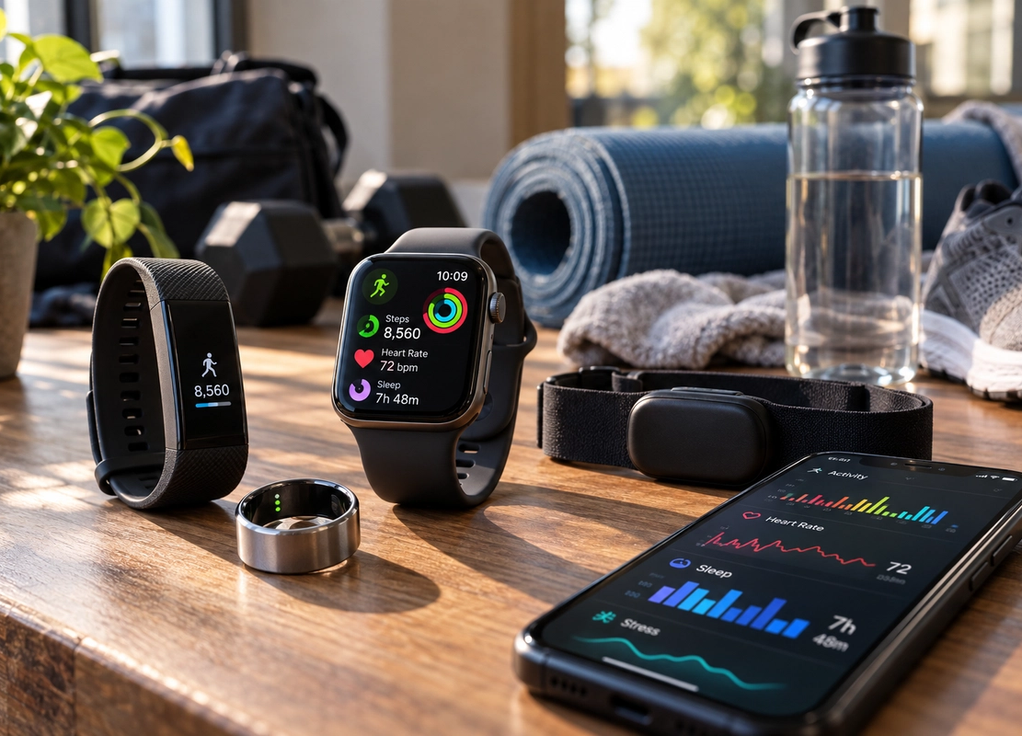
Smartwatches are the best all-around option
For most people who want one device, a good smartwatch or fitness watch offers the most practical combination of features.
Modern watches can track steps, workouts, heart rate, distance, pace, and general activity while also offering everyday functions such as notifications, timers, navigation, and contactless payments depending on the model.
For runners and cyclists, GPS is particularly useful.
Instead of estimating how far you traveled, a GPS-enabled watch can record the route and provide information about pace, distance, elevation, and training history.
The real value appears over time.
One individual run is interesting.
Six months of training data can reveal patterns.
You can see whether your weekly distance has increased, whether your usual running pace has changed, or whether you have actually been exercising as consistently as you imagined.
Fitness rings are useful when you hate sleeping in a watch
Smart rings have become popular partly because they solve a very practical problem.
Some people simply do not want a watch on their wrist 24 hours a day.
A ring can be less intrusive, particularly overnight, while still collecting information about sleep, resting heart rate, activity, and other physiological signals depending on the device.
That can make rings appealing for people primarily interested in general wellness and recovery trends rather than detailed live workout statistics.
Their weakness is almost the opposite of their strength.
A ring is discreet because it does not have a large display.
That makes it less useful for someone who wants to glance at running pace, cycling distance, or workout information while exercising.
The right choice therefore depends on what you actually want to track.
Chest straps still make sense for serious heart-rate training
For people who care specifically about heart-rate accuracy during exercise, chest-strap monitors remain useful.
Wrist-based optical sensors have improved enormously, but measuring heart rate from the wrist can become more difficult during certain types of movement or rapid changes in intensity.
A chest strap measures the electrical activity associated with heartbeats and can provide more responsive heart-rate information during training.
That matters more for some athletes than others.
If you simply want to know whether your afternoon walk counted as exercise, a chest strap is probably unnecessary.
If your training is deliberately structured around heart-rate zones, intervals, and performance data, better measurement can become worthwhile.
This is an important rule for wearables generally: the more precisely you intend to use a metric, the more measurement quality matters.
Step counting is simple but surprisingly useful
Steps may be one of the least glamorous metrics available.
They may also be among the most behaviorally useful.
A step count gives you an understandable approximation of how much you moved during the day.
It can reveal differences that are easy to miss.
You might exercise for an hour but spend the remaining day almost completely sedentary. Another day might contain no formal workout but involve hours of walking.
Step counts make those differences visible.
There is no magical universal number that every person must reach.
The useful part is establishing your own baseline and recognizing whether your everyday movement is increasing or decreasing.
Simple information that changes behavior can be more valuable than sophisticated information you never use.
Sleep tracking is useful for trends, not perfect truth
Sleep tracking is one of the most appealing wearable features.
It is also one of the easiest to overinterpret.
Consumer devices can estimate when you fell asleep, how long you slept, and how often you appeared to wake. Many also estimate different sleep stages.
But a wearable on your wrist or finger is not the same thing as a clinical sleep study measuring brain activity and other physiological signals.
That distinction matters.
If your device says you received exactly 47 minutes of deep sleep, you should not necessarily treat that number as unquestionable truth.
The broader pattern may be more useful.
Are you consistently sleeping six hours when you thought you were getting seven and a half?
Does your sleep duration drop every weekend?
Do late nights repeatedly correspond with worse next-day training?
Wearables can be excellent pattern detectors even when individual estimates are imperfect.
Recovery scores are useful summaries, not instructions
Many wearables now produce a daily recovery, readiness, or body-battery-style score.
These scores typically combine several signals such as recent sleep, heart-rate patterns, activity, and heart-rate variability.
The result might tell you that you are 82% recovered or that today’s readiness is 54.
This is convenient because the device turns multiple measurements into one understandable number.
But the simplicity can create false authority.
Your wearable does not know everything happening in your body or life.
If you feel excellent but your watch produces a mediocre recovery score, you do not necessarily need to cancel your workout.
Likewise, a perfect readiness score does not mean you should ignore genuine fatigue or pain.
Use the score as another piece of information, not as permission from a tiny electronic coach.
Heart-rate variability can be valuable when viewed over time
Heart-rate variability, commonly shortened to HRV, measures variation in the timing between heartbeats.
Many wearables use it as one input for estimating stress and recovery.
The problem begins when users compare their HRV with everyone else’s.
Individual baselines vary substantially.
A number that is normal for one person may be unusual for another.
That makes trends more informative than competition.
If your measurements are collected consistently and your HRV changes significantly relative to your normal pattern, that may provide useful context alongside sleep, training load, illness, stress, and how you actually feel.
The number becomes less useful when treated as a daily grade on your health.
Calorie-burn estimates deserve skepticism
One of the most tempting wearable numbers is calories burned.
It looks wonderfully precise.
Your watch might announce that your workout burned 437 calories.
The problem is that energy expenditure is difficult to estimate accurately outside controlled conditions.
Wearables use information such as movement, heart rate, age, body size, and proprietary algorithms to generate estimates.
That can provide rough context.
It should not automatically be treated as an exact measurement.
This becomes particularly problematic when people use estimated exercise calories to make equally precise eating decisions.
A number displayed to the nearest calorie is not necessarily accurate to the nearest calorie.
Precision on a screen should not be confused with precision in measurement.
Blood oxygen readings can be interesting but need context
Some consumer wearables can estimate blood oxygen saturation.
That feature sounds medical because pulse oximeters are used in healthcare.
But consumer wearable readings should not automatically be treated as equivalent to clinical assessment.
Sensor placement, movement, circulation, device fit, skin conditions, and other factors can affect measurements.
For a generally healthy person, occasional readings may simply provide another trend.
If someone is using oxygen saturation information because of a medical condition or concerning symptoms, decisions should be based on appropriate medical guidance and validated equipment rather than assuming a smartwatch can replace clinical tools.
This principle applies to health wearables broadly.
Consumer technology can provide useful information without becoming a doctor.
Stress scores can oversimplify a complicated experience
Wearables increasingly claim to measure stress.
Usually they are not directly measuring whether your boss annoyed you or whether you are worried about tomorrow.
They are detecting physiological signals and using algorithms to estimate states associated with stress or recovery.
Those signals can be useful.
But physiological stress has many causes.
Exercise is stress.
Illness can create stress.
Poor sleep can affect the same measurements.
Alcohol, travel, dehydration, and emotional experiences can influence them too.
A wearable may detect that something has changed without knowing exactly why.
That is very different from reading your mind.
Continuous glucose monitors are not automatically useful for everyone
Continuous glucose monitors have moved beyond diabetes care into the broader wellness market.
For people who medically need glucose monitoring, these devices can be extremely important.
The argument becomes less clear when healthy people without a clinical reason begin continuously tracking glucose because they have been told every temporary rise is dangerous.
Eating carbohydrates naturally affects blood glucose.
A graph showing a change does not automatically mean something harmful happened.
More data is not always more health.
Sometimes it simply creates more opportunities to worry about normal physiology.
The most overhyped wearable is the one that changes nothing
Imagine your device tells you that you slept badly.
You already knew that.
It tells you that you barely moved yesterday.
You already knew that too.
It says your recovery is poor after you stayed up late, drank alcohol, and completed a hard workout.
Again, not exactly a mystery.
Wearables become valuable when information changes behavior.
Maybe seeing your sleep duration encourages you to go to bed earlier.
Perhaps step tracking reminds you to walk during sedentary workdays.
Training data may help you increase running volume gradually instead of guessing.
Those are meaningful uses.
Collecting thousands of data points without changing anything is mostly digital decoration.
The best wearable disappears into your routine
A good wearable should make understanding your habits easier, not turn your body into a spreadsheet you constantly need to optimize.
For most people, the useful measurements are surprisingly basic: movement, workout frequency, heart rate during exercise, running or cycling distance, and broad sleep trends.
More specialized athletes may benefit from GPS performance data, chest-strap heart-rate monitoring, training-load analysis, or recovery trends.
Medical measurements belong in a different category and require more caution.
The central question is simple.
What decision will this number help you make?
If you cannot answer that, you probably do not need to measure it.
The smartest fitness wearable is not necessarily the one with the longest specification sheet. It is the one that quietly helps you move more, train more intelligently, sleep better, or understand your habits—without convincing you that every fluctuation in your body needs a score.