The Real Difference Between the Premier League, La Liga, and Bundesliga
Jade josef
September 19, 2026
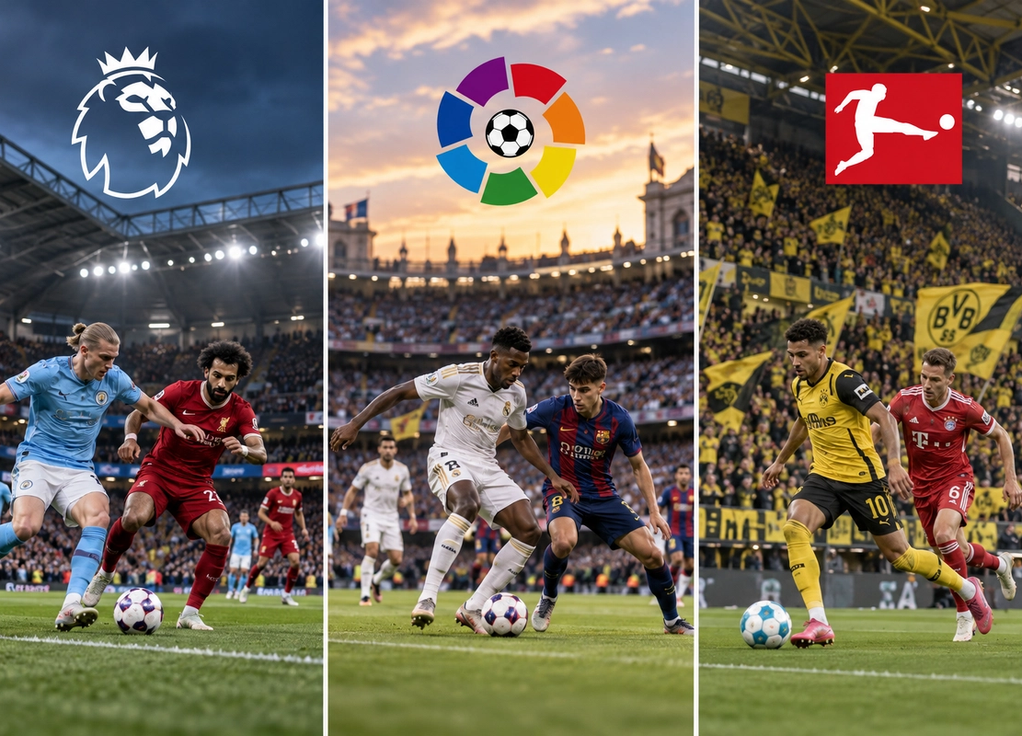
The Premier League, La Liga, and Bundesliga all play the same sport under essentially the same basic laws. A goal in England is worth exactly as much as a goal in Spain or Germany, and the fundamental objective never changes. Yet watching matches from these leagues can feel surprisingly different.
Part of that comes from tactics, but the differences go much deeper. Each league developed within a different football culture, economic system, broadcasting environment, and relationship between clubs and supporters. Those forces influence which players arrive, how teams build squads, what supporters expect, and even how matches tend to feel.
There are plenty of exceptions, and modern coaches constantly borrow ideas from one another. Still, understanding the traditional identities of these three leagues gives a new fan a useful map of European soccer.
The Premier League is built around enormous financial power
England’s Premier League has become the richest domestic soccer league in the world, largely because of its enormous broadcasting and commercial reach.
That money changes the competition.
English clubs outside the traditional group of giants can often spend transfer fees and salaries that would be difficult for similarly placed clubs in many other European leagues. As a result, talented players and coaches arrive from virtually every major soccer market.
This creates unusual squad depth.
A mid-table Premier League team can have internationals sitting on its bench. Newly promoted clubs may spend heavily simply to survive.
The financial strength also creates intense competition throughout the table. Teams are not only fighting for the title. They are competing for European qualification, league position, and survival because remaining in the Premier League carries enormous financial value.
English soccer traditionally emphasizes intensity
The stereotype of English football is speed, physicality, direct attacks, crosses, tackles, and relentless running.
Modern Premier League soccer is much more tactically sophisticated than that stereotype suggests.
Elite coaches from around the world have introduced positional play, aggressive pressing, sophisticated buildup structures, inverted full-backs, flexible formations, and detailed possession systems.
But the league still often has an unmistakable intensity.
Matches can transition rapidly from one end of the field to the other. Crowds respond enthusiastically to tackles, pressing, counterattacks, and moments of physical commitment.
Even technically dominant teams must usually be prepared for opponents willing to press aggressively and attack quickly.
The Premier League’s identity now comes partly from combining traditional English intensity with tactical ideas imported from across the world.
La Liga has traditionally emphasized technical control
Spanish soccer developed a different reputation.
La Liga has historically placed enormous value on technical quality, intelligent positioning, passing, and control of possession.
The global influence of FC Barcelona’s possession-heavy football strengthened this association, particularly during the era when Spanish soccer became closely connected with concepts such as tiki-taka.
But reducing La Liga to Barcelona-style possession would be misleading.
Spanish clubs have produced many different tactical identities. Real Madrid became famous for devastating attacking transitions as well as technical quality. Atlético Madrid built successful teams around defensive organization, intensity, and disciplined counterattacking.
The broader Spanish tradition is less about one formation and more about comfort with the ball.
Even players in deeper positions are often expected to receive possession under pressure, recognize spaces, and participate technically in buildup.
Spanish soccer treats midfield as an intellectual space
One reason La Liga has produced so many celebrated midfielders is the cultural importance placed on controlling the middle of the field.
Spanish soccer has historically celebrated players capable of manipulating space through passing and movement rather than simply overpowering opponents physically.
The best midfielders constantly scan the field before receiving the ball. They understand where pressure is coming from, where the next passing option will appear, and how moving a few meters can change the entire structure of an attack.
This makes some Spanish matches feel almost positional.
Teams are not merely trying to move the ball forward as quickly as possible.
They are trying to move opponents until the right space appears.
For fans who enjoy tactical possession and technical combinations, this can be one of La Liga’s most interesting characteristics.
The Bundesliga often celebrates attacking football
German soccer has developed a strong association with aggressive attacking, pressing, transitions, and vertical movement.
The concept of Gegenpressing—roughly describing an aggressive attempt to regain possession immediately after losing it—became internationally associated with German coaching.
The idea is simple.
When your team loses the ball, the opponent may temporarily be disorganized while transitioning into attack. Instead of immediately retreating, your players aggressively pressure the ball and nearby passing options.
Win possession back quickly and you may suddenly have an excellent attacking opportunity.
This philosophy helped shape a generation of German coaches and influenced soccer far beyond the Bundesliga.
German matches can therefore feature rapid transitions, intense pressing, and teams willing to attack space quickly after recovering possession.
German clubs have a distinctive relationship with supporters
The Bundesliga also stands apart because of German football’s ownership culture.
The famous “50+1” framework generally aims to preserve significant voting control for club members rather than allowing outside investors to freely take majority control in the way possible in many other leagues, although German football includes particular exceptions and complexities.
That structure reflects a broader cultural emphasis on clubs as community institutions.
German stadiums are also famous for large, organized supporter sections and relatively accessible matchday culture compared with some elite European competitions.
Borussia Dortmund’s Südtribüne, commonly associated with the “Yellow Wall,” became one of the most recognizable supporter sections in world soccer.
The result is a league where supporter culture often feels central to the product rather than simply surrounding it.
The leagues have different economic hierarchies
All three competitions contain wealthy clubs, but their financial structures differ.
The Premier League distributes enormous broadcasting revenues across its clubs, giving teams throughout the division substantial spending power.
La Liga contains globally enormous institutions such as Real Madrid and Barcelona, but the financial gap between the biggest Spanish clubs and many smaller teams has historically been significant.
Germany has its own hierarchy, with Bayern Munich occupying an unusually powerful position for much of the Bundesliga’s modern history.
These structures influence squad building.
An English mid-table club may be able to compete financially for a player wanted by a strong Spanish or German club.
A Bundesliga team may instead place greater emphasis on developing young talent before selling players at significant profits.
Spanish clubs frequently draw on strong academies and technically skilled domestic talent while also recruiting extensively from international markets.
Germany has become famous for developing young players
The Bundesliga has developed a particularly strong reputation as an environment where young players can receive meaningful first-team opportunities.
German clubs often recruit promising players before they become global superstars, give them significant playing time, develop them, and potentially sell them later for large transfer fees.
That model makes financial sense for clubs that cannot permanently compete with Europe’s richest teams for established stars.
It also makes the Bundesliga interesting for fans who enjoy discovering elite players early.
A teenager who appears relatively unknown one season can become one of Europe’s most valuable players a few years later.
The league effectively becomes both a major competition and an important development environment.
The atmospheres feel different too
English stadium culture tends to emphasize songs, chants, rivalries, and the closeness of many traditional grounds to the pitch.
Spanish football can feel particularly intense around major regional and historical rivalries, where club identity is often intertwined with local culture.
German supporter culture frequently features enormous standing sections, coordinated displays, flags, drums, and highly organized groups of supporters.
None is universally “better.”
They simply reflect different traditions.
A major match at Anfield does not feel like a Clásico in Spain, and neither feels exactly like a packed evening at Borussia Dortmund.
That variation is one reason European soccer remains so culturally interesting.
Tactical stereotypes are becoming less reliable
There is one major problem with describing leagues through playing styles: modern soccer is extremely international.
A Spanish coach can manage an English team filled with Portuguese, French, Brazilian, Belgian, and Argentine players. A German coach can introduce pressing concepts in England. An Italian coach can transform a Spanish club.
Ideas travel almost instantly.
Premier League teams now play sophisticated possession football. Spanish teams can press aggressively. Bundesliga clubs can defend deeply and counterattack.
So it is better to think of league identities as tendencies and traditions rather than fixed rules.
Modern soccer constantly mixes them together.
The biggest difference is the ecosystem around the game
For a casual fan choosing between the leagues, the differences become easier to understand when you stop asking which one plays the “best” soccer.
The Premier League offers enormous financial resources, international stars, deep squads, and intense competition across much of the table.
La Liga carries a deep tradition of technical football, tactical control, enormous historic clubs, and distinctive regional identities.
The Bundesliga combines elite soccer with strong supporter culture, player development, pressing traditions, and a club structure shaped by Germany’s particular approach to ownership.
All three have world-class players. All three produce tactical innovation. All three can deliver spectacular matches.
What changes is the environment surrounding those matches.
And once you watch them regularly, you begin recognizing those differences before anyone even tells you which league is on.