
The Fundamentals of Baseball Every New Fan Should Know
Connor Doyle
September 19, 2026
Baseball can look strangely slow and complicated when you first watch it. Players spend long stretches standing in position, commentators use statistics that sound like another language, and then suddenly everyone starts running because a ball was hit into a tiny gap.
Once you understand the basic structure, though, baseball becomes much easier to follow.
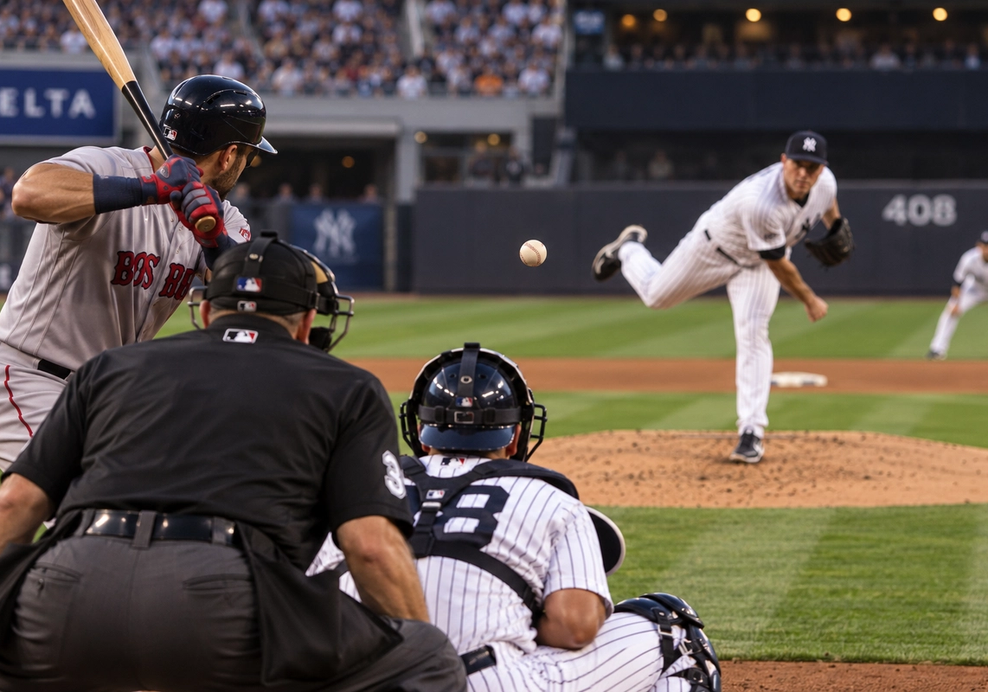
At its core, the game is a repeated battle between a pitcher and a hitter. The pitcher tries to prevent the hitter from reaching base. The hitter tries to put the ball in play or reach base another way. If hitters successfully move around four bases and return home, their team scores a run.
Almost everything else in baseball grows from that simple contest.
The goal is to score runs
A baseball field contains four bases arranged in a diamond: home plate, first base, second base, and third base.
A hitter begins at home plate. If he successfully reaches first base, he becomes a runner. From there, the objective is to advance to second, then third, and eventually return to home plate.
Completing that journey scores one run.
Unlike basketball or football, there is no game clock controlling possession. Instead, baseball is organized around outs and innings.
Each team gets opportunities to hit until the defense records three outs. The teams then switch roles.
That basic cycle drives the entire game.
A game is divided into nine innings
A standard professional baseball game is scheduled for nine innings.
Each inning has two halves.
During the top half, the visiting team bats while the home team plays defense. During the bottom half, the home team bats and the visiting team defends.
Once three outs are recorded, that half of the inning ends.
After both teams have had their turn hitting, one full inning is complete.
If the score is tied after nine innings, the game can continue into extra innings until a winner is determined under the competition’s applicable rules.
This makes baseball fundamentally different from timed sports. A team cannot simply protect a lead by allowing the clock to expire. The defense still has to record the necessary outs.
The pitcher and hitter control the action
Almost every play begins with the pitcher throwing the ball toward home plate.
The hitter decides whether to swing.
The pitcher’s objective is not simply to throw as hard as possible. Pitchers change speeds, locations, and movement to make hitting difficult.
A fastball may arrive extremely quickly. A breaking ball can move dramatically as it approaches the plate. A changeup is designed to look faster than it actually is, potentially causing the hitter to swing too early.
The hitter is trying to identify all of this in a fraction of a second.
That confrontation is one of baseball’s defining features: every pitch becomes a small strategic battle.
Balls and strikes determine the count
Every pitch contributes to what baseball calls the count.
A strike can occur when the hitter swings and misses, when the hitter does not swing at a pitch that passes through the strike zone, or in certain situations when the hitter hits the ball foul.
Three strikes generally produce a strikeout, meaning the hitter is out.
A ball is generally called when a pitch misses the strike zone and the hitter does not swing.
Four balls result in a walk, allowing the hitter to advance to first base.
This creates an important strategic tension.
A hitter with three balls knows that another ball will give him first base. A hitter with two strikes knows another strike can end the plate appearance.
Pitchers and hitters adjust their strategies accordingly.
Hits come in different forms
When a hitter successfully puts the ball into play and reaches base safely, it may be recorded as a hit.
A single allows the hitter to reach first base. A double reaches second. A triple reaches third.
Then there is the home run.
A home run usually occurs when the hitter sends the ball over the outfield fence in fair territory. The hitter and any runners already on base are allowed to score.
If nobody is on base, the home run produces one run. With one runner aboard, it produces two. With two runners, it scores three.
If all three bases are occupied, a home run scores four runs. This is called a grand slam.
Home runs are spectacular, but teams can score without them by combining walks, singles, doubles, stolen bases, and other productive plays.
The defense needs three outs
The defensive team’s immediate objective is to record outs.
There are several ways to do this.
A pitcher can strike out the hitter. A defender can catch a batted ball before it touches the ground. A runner can be tagged with the ball while not safely touching a base. The defense can also record a force out by getting the ball to a base before a runner who is required to advance reaches it.
Sometimes one play produces multiple outs.
A double play records two outs, often when a ground ball allows defenders to retire a runner at second base and then throw to first in time to retire the hitter.
Those plays can completely change an inning.
An offense that appeared to be building a dangerous situation can suddenly find itself with two additional outs.
The nine defensive positions have different jobs
Baseball uses nine defensive players.
The pitcher throws from the mound, while the catcher receives pitches behind home plate and helps coordinate the defense.
Four players make up the traditional infield: the first baseman, second baseman, shortstop, and third baseman. They primarily handle balls hit around the inner part of the field.
Three outfielders—left fielder, center fielder, and right fielder—cover the much larger area beyond the infield.
Each position requires different skills.
Shortstops often need excellent range and throwing ability. First basemen regularly receive throws from other infielders. Center fielders may have to cover enormous distances to catch balls.
The positioning can change depending on the hitter and situation.
Runners create another layer of strategy
Getting on base is only the beginning.
Once a runner reaches first, second, or third, the defense has another problem to manage.
Runners can attempt to steal bases, advancing while the pitcher delivers the ball. They can also move when teammates hit safely or sometimes advance on outs.
This creates constant strategic calculations.
A runner on second base is much more dangerous than one on first because many ordinary hits can allow him to score.
A runner on third with fewer than two outs creates even more possibilities. The offense may be able to score without recording a traditional hit.
Baseball therefore becomes increasingly tense as runners move closer to home.
Pitching changes throughout the game
Teams generally begin with a starting pitcher.
The starter may remain in the game for several innings, but pitchers rarely complete every game in modern professional baseball. Eventually, the manager usually turns to relief pitchers from the bullpen.
Different relievers can have different roles.
Some specialize in particular matchups. Others are used during crucial late-game situations. A team’s best late-inning reliever may be trusted to protect a narrow lead near the end of the game.
Pitching changes introduce strategy because managers must decide when a pitcher is becoming less effective and which replacement provides the best matchup.
Once you start recognizing these decisions, the later innings become much more interesting.
Baseball statistics tell different parts of the story
Baseball has always loved statistics.
Batting average measures how frequently a player records a hit in official at-bats. On-base percentage focuses more broadly on how often a hitter reaches base. Slugging percentage attempts to capture hitting power by giving more weight to extra-base hits.
Pitchers have their own statistics, including earned run average, strikeouts, walks, and many more advanced measurements.
You do not need to understand all of them to enjoy baseball.
For a new fan, start with the basics: runs, hits, home runs, strikeouts, walks, and the score.
The deeper statistics become more useful once the structure of the game feels natural.
Baseball becomes easier when you watch the situation
The simplest way to understand baseball is to ask four questions before each pitch: What is the score? What inning is it? How many outs are there? Are there runners on base?
Those four pieces of information explain much of the strategy.
A team trailing by one run in the ninth inning with a runner on second and nobody out will approach the situation very differently from a team leading comfortably in the third inning with nobody on base.
Once you understand the situation, the pauses between pitches stop feeling empty.
They become part of the tension.
That is the secret to watching baseball. The sport is not constant action. It is a sequence of small confrontations in which every pitch changes what can happen next.