How International Tournaments Actually Work (World Cup, Euros, Copa)
Izak Tareb
September 19, 2026
International soccer can be confusing if you mainly follow club football. Players who spend most of the year competing against one another suddenly become teammates for their countries, domestic leagues pause for international matches, and tournaments such as the World Cup, European Championship, and Copa América seem to appear on completely different schedules.
The basic distinction is simple. Club teams employ players throughout the regular season, while national teams select eligible players to represent their countries during designated international periods and major tournaments.
The biggest competitions then bring those national teams together to determine continental or world champions. The World Cup, Euros, and Copa América all follow this basic idea, but they differ in geography, qualification, size, and history.
National teams are different from club teams
A player can represent a club such as Real Madrid, Liverpool, Bayern Munich, or Inter Milan while also playing international soccer for an eligible national team.
The two systems operate separately.
Clubs sign players through contracts and transfers. National teams do not buy players. Instead, coaches select eligible players based on nationality and the international eligibility rules governing the sport.
This creates fascinating combinations.
Players who are fierce club rivals can become national-team partners. Teammates at club level may suddenly face one another internationally.
National-team coaches also have far less time with their players than club coaches do, which can influence tactics. They cannot spend an entire season teaching complicated systems.
International soccer therefore often places enormous value on adaptability, chemistry, and making the most of limited preparation time.
The World Cup is the global championship
The FIFA World Cup is the largest and most prestigious men’s national-team tournament.
Unlike a domestic league, countries from around the world must qualify through regional competitions.
Soccer is divided into continental confederations covering areas such as Europe, South America, North and Central America and the Caribbean, Africa, Asia, and Oceania.
Each region operates its own qualification process within the broader system.
The World Cup itself has changed formats several times throughout its history. The 2026 men’s tournament expands to 48 teams, making it significantly larger than the 32-team format used from 1998 through 2022.
That expansion also changes how the tournament progresses from the group stage into the knockout rounds.
Qualification happens long before the tournament
One of the biggest differences between international soccer and many other major sports is how long the qualification process can feel.
Countries play qualifying matches over an extended period before the tournament.
In Europe, for example, national teams compete against other European countries for World Cup qualification places. South American countries compete through CONMEBOL’s qualification structure, while other confederations operate their own systems.
This means major soccer nations can theoretically fail to qualify.
History and reputation do not automatically guarantee a place.
That creates pressure long before the actual World Cup begins.
A disappointing qualifying campaign can eliminate a strong team before the tournament itself.
The group stage rewards consistency
Major international tournaments generally begin with some form of group stage before moving into knockout soccer.
Teams are placed into groups and play a limited number of matches.
A win normally earns three points, a draw earns one, and a loss earns zero.
Teams are then ranked according to points, with tournament rules providing additional tiebreakers when teams finish level.
The exact number of teams advancing depends on the competition and format.
This creates a different strategic environment from knockout soccer.
Losing one group match does not necessarily eliminate a team.
But because there are relatively few matches, every result matters enormously.
A surprise draw against a weaker opponent can completely change the group.
Knockout soccer changes the psychology
Once the tournament enters the knockout rounds, the calculation becomes brutally simple.
Win and continue.
Lose and go home.
If a knockout match is tied after regulation time, the competition’s rules determine the next step. In many major tournaments, matches can proceed to extra time and then, if still tied, a penalty shootout.
This creates a completely different tactical environment.
A team might dominate possession during the group stage because it needs victories.
In a knockout match against a stronger opponent, the same team might defend compactly, accept long periods without the ball, and attempt to survive until one counterattack or set piece creates an opportunity.
Tournament soccer rewards teams that can manage different types of matches.
The Euros determine Europe’s champion
The UEFA European Championship, commonly called the Euros, brings together Europe’s leading national teams.
It is normally held every four years.
Qualification determines most participants, while the host arrangement provides qualification treatment according to the rules for that edition.
The Euros can feel almost as difficult as the World Cup because European soccer contains an unusually dense concentration of historically strong national teams.
Countries such as Germany, France, Spain, Italy, England, Portugal, and the Netherlands may all participate in the same tournament, alongside nations capable of producing major surprises.
The competition begins with group play before moving into knockout rounds.
For European supporters, winning the Euros represents one of the biggest achievements available to a national team.
Copa América is South America’s historic championship
Copa América is the major men’s national-team championship associated with South America’s CONMEBOL federation.
Its history stretches back more than a century, making it the oldest existing continental international soccer tournament.
South America has fewer countries than Europe, which gives Copa América a different structure and competitive environment.
Traditional powers such as Brazil, Argentina, and Uruguay carry enormous historical importance, but other South American nations have produced exceptional teams and tournament runs.
Guest teams from outside South America have also participated in various editions, depending on the tournament’s format.
Copa América often carries an intense rivalry culture because many participating countries have faced one another repeatedly across generations.
Continental tournaments matter beyond trophies
The Euros and Copa América are not simply smaller versions of the World Cup.
They have their own histories and rivalries.
Winning a continental championship can define a generation of players.
It can also change how a national team approaches the next World Cup.
A young squad might use a continental tournament to gain experience. A coach may establish a tactical system that becomes the foundation for a later World Cup campaign.
These competitions also provide legendary players with additional opportunities to build international legacies.
Club greatness and international greatness are often discussed separately in soccer because success with a national team carries a different kind of cultural significance.
International squads create difficult selection decisions
National-team coaches cannot simply sign a replacement when they have a weakness.
They must work with eligible players.
If a country produces several world-class goalkeepers but lacks elite strikers, the coach cannot enter the transfer market and buy one.
That makes player development at the national level extremely important.
Coaches must also decide which players fit together.
Selecting the 23 or more individually most famous players does not necessarily create the strongest squad.
A team needs defenders, midfield balance, backup options, different attacking profiles, and players willing to accept smaller roles.
Tournament squads are exercises in limited-resource planning.
Injuries become especially painful
Major international tournaments happen within relatively short windows.
That makes injuries particularly damaging.
A player injured during a club season may recover several months later and still contribute significantly.
A player injured immediately before a World Cup might miss the entire tournament.
There may be no second opportunity for another four years.
This is one reason international soccer produces such emotional reactions.
A player’s career can contain many domestic seasons but only a handful of realistic World Cup opportunities.
Even legendary players may participate in only three or four World Cups while near their peak.
Penalty shootouts are not ordinary penalties
When a knockout match remains tied and reaches a penalty shootout, the atmosphere changes completely.
Teams take penalties according to the competition’s shootout procedure, with the outcome determining who advances.
Technically, the skill is familiar.
Psychologically, the situation is completely different.
Players may be taking one kick knowing that years of preparation depend on it.
Goalkeepers study penalty tendencies. Players practice preferred placements. Coaches decide who should take each kick.
Yet uncertainty remains enormous.
That combination of preparation and pressure is why penalty shootouts produce some of international soccer’s most famous and painful moments.
International soccer creates identities club soccer cannot replicate
Club soccer may provide the highest level of week-to-week tactical development because teams train together constantly.
International tournaments offer something different.
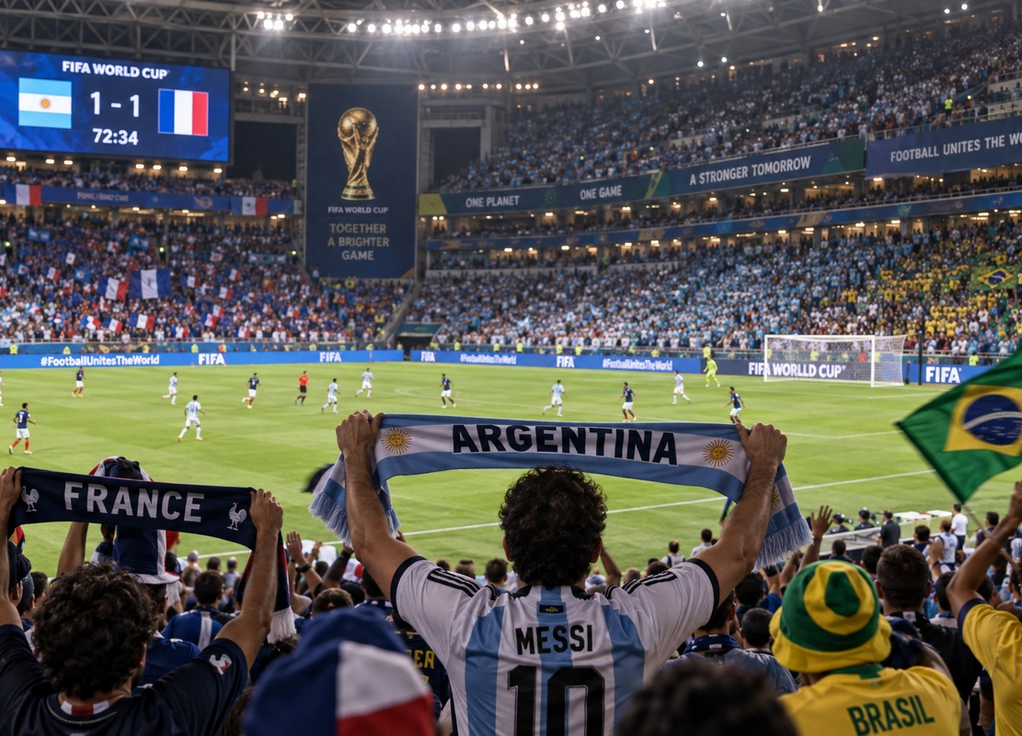
Players represent countries rather than employers. Stadiums fill with national colors. People who barely watch domestic leagues suddenly follow every match.
A World Cup can turn relatively unknown players into national heroes within weeks.
The tournament format intensifies everything because there are so few opportunities to recover from mistakes.
One bad match can end four years of preparation.
One goal can become part of a country’s sporting history.
The easiest way to understand the tournament hierarchy
Think of international soccer as having two major levels.
Continental championships determine regional champions. Europe has the Euros, South America has Copa América, while other confederations operate their own major competitions.
Above them sits the World Cup, where qualified countries from across those regions meet in one global tournament.
The structures and qualification systems can change between editions, but the emotional logic stays remarkably consistent.
Countries spend years qualifying and preparing. They arrive with a limited squad. They survive the group stage if the format includes one. Then the margin for error becomes smaller with every knockout round.
Eventually, two teams remain.
That scarcity is what gives international tournaments their unusual power.
A club can try again next season.
A national team that misses its moment may have to wait four years for another chance.