The Real Cost of a Pro Sports Career (Beyond the Highlights)
Jade josef
September 19, 2026
Professional sports look glamorous from a distance. Packed stadiums, sponsorship deals, international travel, championship celebrations, and enormous salaries dominate the public image of elite athletes.
But those moments represent a tiny fraction of the job.
Behind every highlight is a career built around physical strain, uncertainty, repetition, competition, travel, public judgment, and the uncomfortable knowledge that it could end much earlier than expected.
For the small number of athletes who reach the highest level, professional sport can provide extraordinary opportunities. It can also demand sacrifices that are difficult to understand from the outside.
The career often begins before adulthood
Most professional athletes do not suddenly decide at 22 that they would like to become professionals.
The process usually begins much earlier.
Children showing unusual ability may enter academies, competitive clubs, specialized coaching programs, or intensive training environments while their friends are living relatively ordinary childhoods.
As the level rises, the schedule becomes increasingly serious.
Weekends become competitions. Evenings become practice. Holidays may become training camps and tournaments.
Families can make significant sacrifices too, spending years driving to practices, paying for equipment, traveling to competitions, and reorganizing family life around the possibility of a career that may never happen.
By the time the public discovers an athlete, years of invisible investment have often already taken place.
Most aspiring professionals never reach the top
Elite sport is built like a pyramid.
Huge numbers of young athletes participate at the bottom.
Far fewer progress into serious competitive programs.
Fewer still reach professional leagues.
And only a tiny group become internationally recognizable stars.
This creates an uncomfortable reality.
Many aspiring athletes dedicate enormous portions of their youth to a career they will never actually have.
That does not make the experience worthless. Competitive sport can provide friendships, discipline, education, travel, and other opportunities.
But the probability structure matters.
Professional sports produce famous success stories precisely because reaching that level is unusual.
The body becomes part of the job
Most workers can separate themselves from the equipment they use.
Athletes cannot.
Their body is the equipment.
If something stops functioning correctly, their ability to work may immediately change.
A hamstring injury can affect a sprinter’s season. A shoulder problem can alter a swimmer’s training. A knee injury can interrupt a soccer player’s career.
Even smaller physical problems matter at elite levels because the difference between excellent and slightly below excellent can determine whether someone competes.
Athletes therefore spend enormous amounts of time maintaining their bodies.
Training is only part of it.
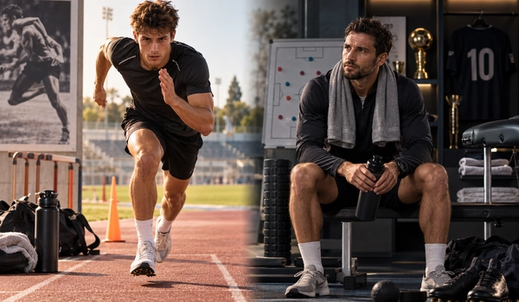
There may also be physiotherapy, rehabilitation exercises, mobility work, strength sessions, medical appointments, massage, nutrition planning, and carefully managed recovery.
Pain can become strangely normal
Professional sport places demands on the body that ordinary recreational exercise usually does not.
Athletes repeat movements thousands of times, absorb collisions, train through demanding schedules, and compete while managing minor physical problems.
As a result, the distinction between being completely pain-free and being capable of competing can become complicated.
An athlete may not technically be injured but may still be managing soreness or discomfort.
This does not mean athletes should ignore injuries.
It means elite competition creates strong incentives to remain available.
There is always another match, race, tournament, or selection decision approaching.
That pressure can make rest psychologically difficult even when the body needs it.
Injuries carry professional consequences
For recreational athletes, an injury is frustrating.
For professionals, it can affect employment.
Missing competition may mean losing a starting position.
A younger athlete may receive an opportunity.
A contract negotiation may arrive at the wrong moment.
Selection for an important tournament may disappear.
In individual sports, the consequences can be even more direct. If an athlete cannot compete, they may lose prize money and sponsorship opportunities while still paying coaches, travel expenses, and other costs.
Recovery therefore contains an uncomfortable contradiction.
The athlete needs enough time to heal properly.
But the career continues moving while they are absent.
Travel is less glamorous when it becomes routine
Travel looks like one of the best parts of professional sport.
And sometimes it is.
But traveling for competition is very different from traveling for vacation.
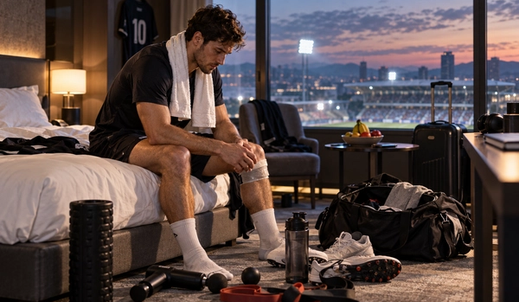
Athletes may spend large portions of the year moving between hotels, airports, training facilities, buses, and stadiums.
Time zones change.
Sleep schedules become disrupted.
Meals happen around competition.
Family events are missed.
A beautiful city can become a place someone sees primarily through the window between the hotel and the venue.
The destination may be glamorous.
The routine often is not.
Relationships have to survive the schedule
Professional sport does not operate around birthdays, weddings, school events, or family holidays.
Competition schedules come first.
Athletes may spend months away from partners and children. They can be transferred to another city or country with little control over timing. Individual athletes may travel internationally for much of the season.
Partners often absorb part of that instability.
Families move.
Careers are adjusted.
Childcare changes.
Long-distance periods become normal.
The public sees the athlete signing with a new team.
The family experiences the relocation.
Privacy can disappear with success
Becoming famous creates opportunities, but it also changes ordinary life.
A recognizable athlete may struggle to eat at a restaurant without being approached.
A bad performance can produce thousands of comments from strangers.
Personal relationships can become public entertainment.
Rumors spread quickly.
Every emotional reaction during competition can be filmed, replayed, and interpreted.
Social media intensified this dramatically.
Athletes no longer hear criticism only from journalists or coaches.
It can arrive directly on their phones seconds after a match.
The same audience that celebrates someone on Saturday may attack them on Sunday.
Performance pressure never completely disappears
Reaching professional sport does not end competition.
It often intensifies it.
A professional athlete is surrounded by other people who were also exceptional growing up.
Every roster spot is valuable.
Every season brings younger competitors.
Contracts expire.
Coaches change.
Teams rebuild.
A player who was essential last year may become replaceable this year.
Even superstars face pressure because expectations rise with success.
Once someone produces an extraordinary season, that performance becomes the new standard.
Achievement does not always reduce pressure.
Sometimes it simply raises the level required next time.
The money is far less predictable than it looks
Public attention naturally focuses on athletes earning enormous contracts.
Those athletes are real.
They are also not representative of every professional sports career.
Income varies dramatically between sports, leagues, countries, genders, levels, and individual athletes.
Some professionals earn extraordinary amounts.
Others earn relatively ordinary salaries.
Athletes in individual sports may also pay significant expenses themselves, including coaching, equipment, travel, accommodation, medical care, and support staff.
A headline announcing millions of dollars in prize money does not show what every competitor earned—or what they spent trying to compete.
Professional athlete does not automatically mean wealthy.
The earning window can be unusually short
Most people expect to work for several decades.
Athletes may have a much shorter period in which their primary skill generates professional income.
A career can end because of injury, declining performance, competition, changing team needs, or simply age.
That makes financial planning unusually important.
Someone earning significant money at 25 cannot automatically assume the same income will exist at 35.
The challenge becomes converting temporary earning power into long-term financial security.
Poor financial decisions can therefore have consequences that become visible only after the applause stops.
Identity can become tied entirely to performance
Many elite athletes have been known as “the athlete” since childhood.
Their routines, friendships, goals, education, travel, and sense of achievement may all revolve around sport.
Then one day the career ends.
The training schedule disappears.
The teammates disappear.
The crowds disappear.
The constant measurement of performance disappears.
For some athletes, retirement is liberating.
For others, it creates a difficult identity transition.
The question changes from “How do I perform better?” to something much larger:
“What do I do now?”
Preparing for life after sport can be just as important as preparing for competition.
There are extraordinary rewards too
None of these costs means professional sport is inherently miserable.
For many athletes, it is the realization of a lifelong dream.
They get to spend years doing something they love at an extraordinary level.
They experience competition few people will ever understand.
They build intense friendships with teammates.
They travel, represent communities or countries, support families financially, inspire young athletes, and create memories that can last a lifetime.
Some earn generational wealth.
Some become cultural icons.
Some simply experience the deep satisfaction of discovering how far their abilities could take them.
The rewards are real.
So are the costs.
The highlights are the smallest part of the career
A professional sports career is often judged through its visible moments.
Goals.
Medals.
Records.
Contracts.
Championships.
But the actual career happens mostly somewhere else.
It happens during rehabilitation at 7 a.m.
It happens during repetitive training sessions.
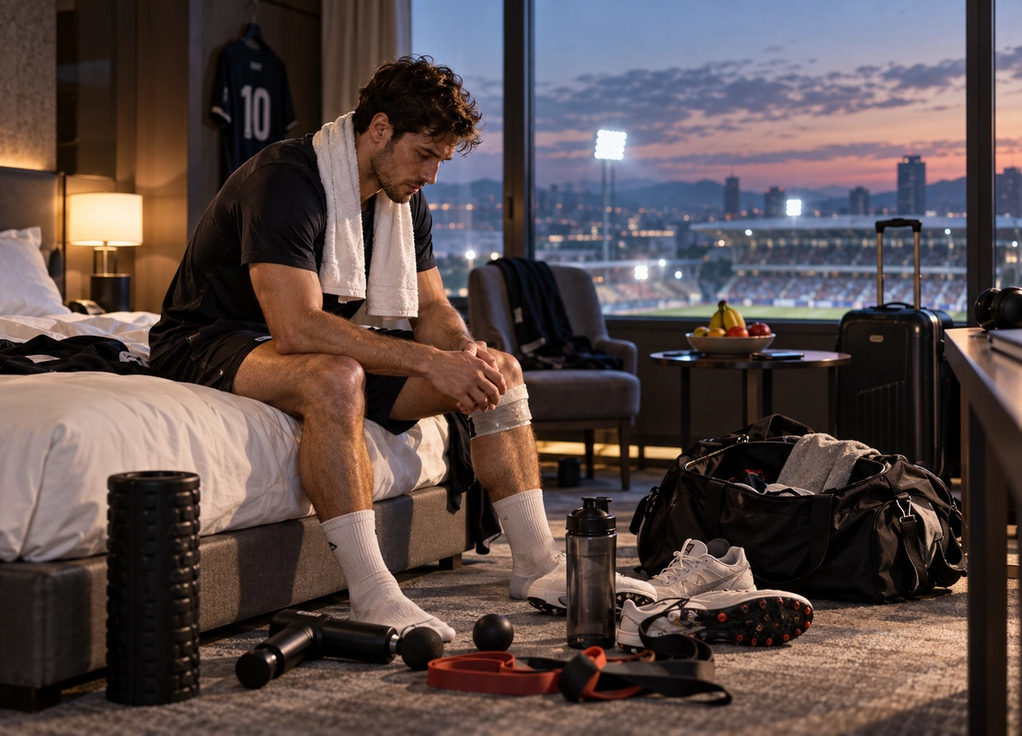
It happens in airports, hotel rooms, recovery sessions, difficult conversations with coaches, missed family events, and quiet evenings preparing to perform again tomorrow.
The highlights are what the public remembers.
The routines sacrifices, uncertainty, and physical demands are what the athlete actually lives.
And understanding that difference makes professional sport even more remarkable—not because every athlete’s life is glamorous, but because the glamorous moments are built on so much that nobody sees.