How Soccer Tactics Have Evolved Over the Decades
Rohan Pierce
September 19, 2026
Soccer’s basic rules have remained recognizable for generations, but the way teams actually play has changed dramatically. Watch footage from the early 20th century and the formations can look almost unrecognizable. Jump forward several decades and defenders begin attacking, forwards drop into midfield, teams press collectively, and goalkeepers suddenly become important passers.
Tactical evolution usually follows the same pattern. Someone discovers an advantage, opponents develop a response, and eventually that response creates the conditions for another idea.
The result is that modern soccer is not based on one tactical revolution. It is the product of more than a century of teams repeatedly solving problems created by the generation before them.
Early soccer was incredibly attack-heavy
Early formations would look bizarre to modern fans because teams regularly used enormous numbers of forwards.
One famous structure was the 2-3-5, sometimes called the Pyramid. It essentially contained two primary defenders, three midfield-like players, and five forwards.
Soccer was more positionally rigid, and specialization was clearer. Defenders defended. Attackers attacked. Players generally did not move through several tactical roles during the same possession in the way modern players often do.
As coaching became more sophisticated, teams realized that adding defensive structure could provide an enormous advantage.
That started a gradual movement away from simply placing as many players as possible near the opponent’s goal.
The WM formation introduced greater structure
One of the important tactical developments of early professional soccer was the WM formation, famously associated with Arsenal manager Herbert Chapman.
Its shape created something resembling a 3-2-2-3 structure.
The important change was balance.
Teams could defend with greater organization while still maintaining enough attacking players to threaten opponents.
Roles became increasingly connected to one another. Instead of treating defense and attack as almost separate units, coaches started thinking more seriously about the team’s overall shape.
That idea seems obvious today.
At the time, it represented an important step toward modern tactical organization.
Hungary showed that forwards did not have to stay forward
During the 1950s, Hungary’s famous national team challenged traditional assumptions about attacking positions.
One important innovation involved the center-forward dropping away from the opposing defensive line rather than remaining permanently near goal.
Defenders suddenly faced a difficult decision.
Should they follow the forward into midfield and leave space behind them?
Or remain in position and allow him to receive the ball freely?
This type of positional movement created confusion because defenders were accustomed to relatively predictable opponents.
The idea would reappear repeatedly throughout soccer history, eventually becoming central to concepts such as the false nine.
The broader lesson was enormous: movement could destroy a defensive structure without anyone needing to dribble past a defender.
Brazil showed that structure and creativity could coexist
Brazil’s great teams demonstrated that tactical organization did not have to eliminate individual freedom.
During the late 1950s and 1960s, Brazil used structures that provided greater defensive balance while allowing extraordinary attacking players to express themselves.
Full-backs became particularly important.
Instead of remaining permanently near their own goal, Brazilian wide defenders could advance and contribute to attacks.
That idea became fundamental to modern soccer.
Today, expecting full-backs to provide attacking width feels completely normal.
But it represented a significant expansion of the defender’s responsibilities.
Players increasingly needed to contribute in multiple phases of the game.
Catenaccio pushed defensive organization further
Italian soccer became closely associated with catenaccio, a defensive philosophy emphasizing organization, marking, compactness, and protection near goal.
The system is sometimes remembered simply as ultra-defensive soccer, but its influence was more sophisticated than that stereotype suggests.
Italian teams demonstrated how carefully coordinated defensive structures could neutralize technically gifted opponents.
The sweeper, positioned behind other defenders, became particularly associated with certain versions of the system.
Once teams became better at defending space, attackers needed new ways to create it.
That tension between increasingly organized defenses and increasingly sophisticated attacks became one of the central engines of tactical evolution.
Total Football broke positional boundaries
The Netherlands and Ajax helped produce one of soccer’s most influential tactical revolutions during the 1960s and 1970s.
Total Football challenged the idea that players needed to remain permanently attached to one position.
If one player moved somewhere else, a teammate could occupy the space he had left behind.
Johan Cruyff became the most famous symbol of this philosophy.
The system required intelligence, technical ability, movement, and collective understanding.
Players had to recognize space rather than simply memorize positions.
The influence is still visible today.
When a modern full-back moves into midfield while a midfielder drops into defense and a winger moves centrally, you are watching a game shaped partly by ideas Total Football helped popularize.
Pressing changed what teams did without the ball
Defending once meant primarily retreating toward your own goal and protecting dangerous areas.
Modern pressing introduced another possibility: attack the opponent while they have possession.
Teams realized that aggressively pressuring opponents could force mistakes before attacks even developed.
This became especially powerful when pressing was coordinated.
One player running toward the ball is easy to pass around.
An entire team moving together can remove multiple passing options simultaneously.
German soccer later became particularly associated with Gegenpressing, or counter-pressing, where teams attempt to regain possession immediately after losing it.
The idea treats the moment after losing the ball as an opportunity rather than simply a defensive emergency.
Arrigo Sacchi made compactness revolutionary
AC Milan under Arrigo Sacchi during the late 1980s became one of the most influential tactical teams in modern soccer.
Sacchi emphasized collective movement, pressing, zonal defending, and compact distances between players.
The team moved almost like one connected unit.
Instead of defenders simply following individual attackers everywhere, players protected spaces and maintained relationships with teammates.
This helped establish a principle that now seems fundamental: the distance between players matters enormously.
A team stretched across the entire field becomes vulnerable.
A compact team can pressure opponents while protecting important spaces.
Modern defensive organization owes a great deal to this development.
The 4-4-2 era prioritized balance
For many fans who grew up watching soccer in the 1990s and early 2000s, the 4-4-2 formation became almost synonymous with football.
Four defenders, four midfielders, and two strikers created an easily understandable structure.
The formation provided natural width, defensive organization, and two central attacking threats.
But tactical evolution eventually exposed weaknesses.
A team playing three central midfielders could potentially outnumber the two central midfielders in a traditional 4-4-2.
That numerical advantage helped encourage greater use of formations such as 4-3-3 and 4-2-3-1.
Once again, tactical change came from teams searching for ways to create extra players in important spaces.
Barcelona made possession a defensive weapon
Barcelona under Pep Guardiola pushed positional possession football to extraordinary levels.
The team did not simply pass because passing looked attractive.
Possession was used to manipulate opponents.
Players occupied carefully selected spaces, creating passing triangles and forcing defenders to make difficult decisions.
Lionel Messi’s movement as a false nine added another problem. When he dropped away from the defensive line, center-backs had to decide whether to follow him.
Barcelona also pressed aggressively immediately after losing possession.
This combination meant opponents could spend long periods without the ball and then face immediate pressure when they finally recovered it.
Possession had become both attack and defense.
Modern full-backs stopped behaving like traditional full-backs
One of the clearest examples of modern tactical evolution is the changing role of wide defenders.
Traditional full-backs generally defended the sides and occasionally moved forward to cross.
Modern versions can do almost anything.
Some overlap outside the winger. Others move inside into central midfield, becoming “inverted” full-backs. Some effectively become additional attackers.
This allows coaches to manipulate numbers in different parts of the field.
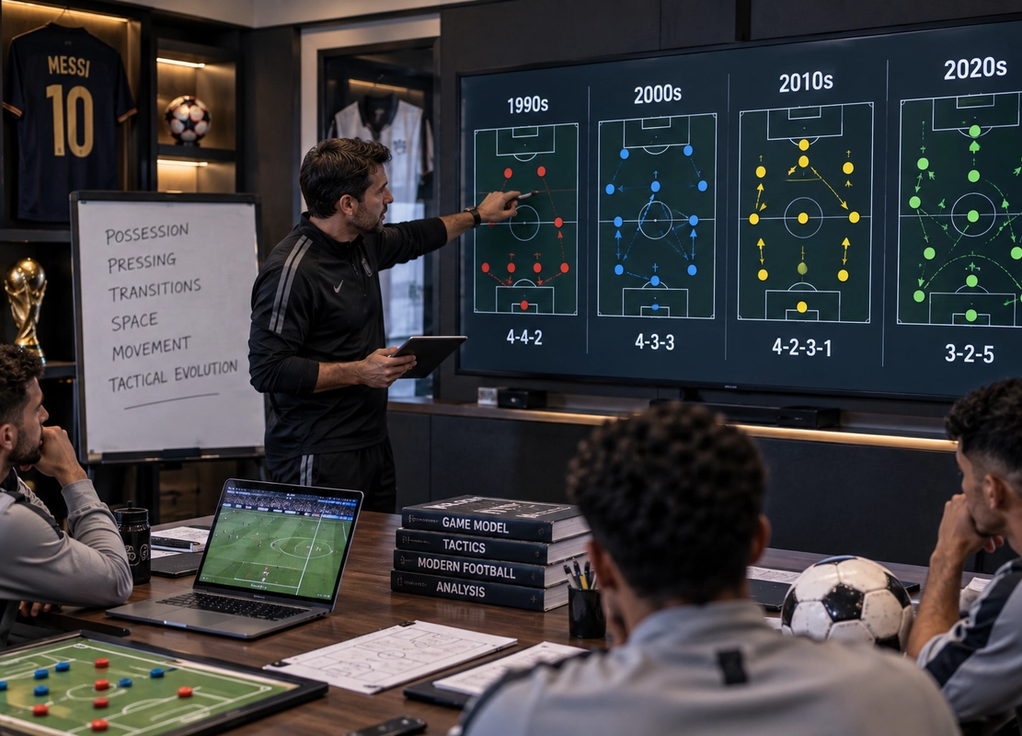
A formation listed as 4-3-3 before kickoff may effectively become 3-2-5 when the team attacks.
That is why modern formations can be misleading.
The starting lineup tells you where players begin.
It does not necessarily tell you where they will spend most of the match.
Goalkeepers became part of buildup play
Goalkeeping has undergone a similar transformation.
Traditionally, the goalkeeper’s main responsibilities were stopping shots, catching crosses, and clearing danger.
Modern teams increasingly expect goalkeepers to pass under pressure.
Why?
Because using the goalkeeper during buildup creates an extra player.
If the opponent presses with two forwards and the goalkeeper joins two center-backs in possession, the team may create a three-against-two numerical advantage.
Some goalkeepers also position themselves far outside the penalty area when their team has possession, effectively acting as a sweeper behind a high defensive line.
The position has evolved from specialist shot-stopper toward something closer to goalkeeper-plus-playmaker.
Modern soccer is increasingly positionless
The biggest tactical trend today may be the gradual disappearance of rigid positional definitions.
Center-backs can move into midfield.
Full-backs can become central midfielders.
Midfielders can drop between defenders.
Wingers can become strikers.
Strikers can drop into midfield.
The best teams constantly manipulate their shape depending on whether they have possession, where the ball is located, and what the opponent is doing.
A team’s defensive formation might be 4-4-2.
Its buildup shape could become 3-2-5.
After losing possession, it may immediately collapse into another structure.
Modern players therefore need more than technical ability.
They need to understand space.
Soccer tactics evolve because every solution creates another problem
There is no final perfect formation.
Defensive organization produced more sophisticated attacking movement. Possession football encouraged aggressive pressing. High pressing created opportunities for teams capable of playing through pressure. High defensive lines made fast attackers running behind them more dangerous.
Every tactical advantage eventually produces a countermeasure.
That is what makes soccer’s evolution so fascinating.
The sport still involves the same basic objective it always has: move the ball toward the opponent’s goal and stop them from doing the same.
But underneath that simplicity is more than a century of accumulated ideas about space, movement, pressure, possession, and positioning.
And the next major tactical revolution will probably begin the same way the previous ones did: with someone noticing a space everyone else has forgotten to use.