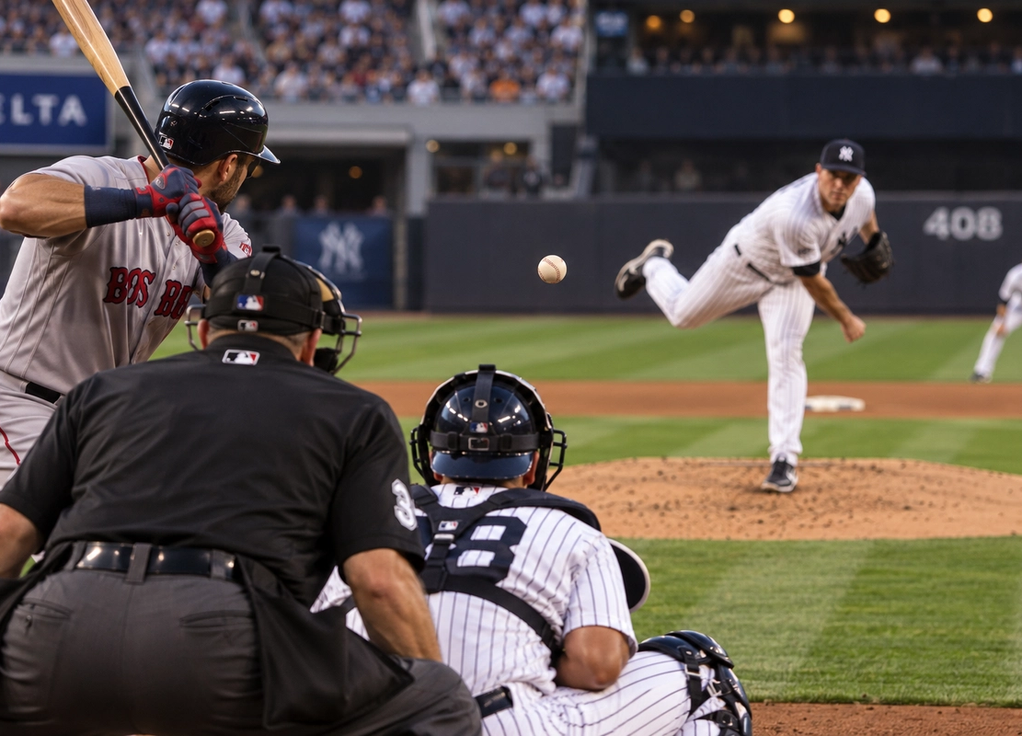
How the Pitcher-Batter Chess Match Actually Works
Rohan Pierce
September 19, 2026
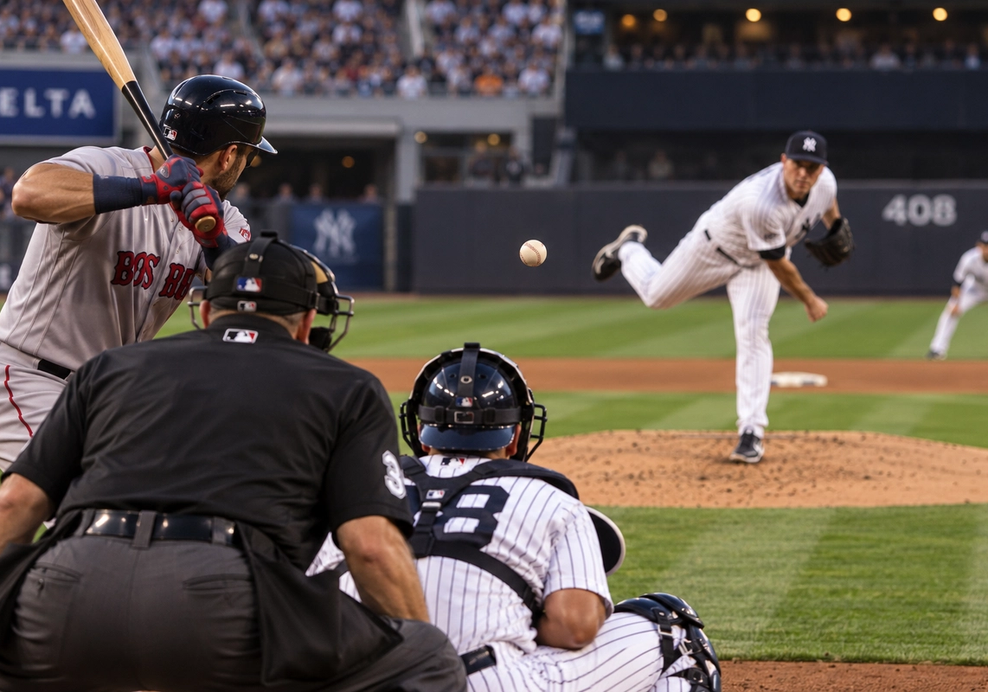
Every baseball pitch looks like a simple confrontation. The pitcher throws the ball. The batter decides whether to swing.
But underneath that basic exchange is a constant game of prediction.
The pitcher is thinking about what the batter expects. The batter is thinking about what the pitcher wants him to expect. The catcher is helping design the sequence. Coaches and analysts have studied both players’ tendencies. Everyone involved knows that the other side has access to much of the same information.
That is why the pitcher-batter matchup is often described as a chess match.
The objective is not merely to throw the hardest pitch or swing the bat the fastest. It is to manipulate expectations until the other person makes the wrong decision.
The count changes everything
The first thing to understand is the count.
Every plate appearance develops according to the number of balls and strikes. Three strikes generally produce an out, while four balls produce a walk.
But the count also changes the balance of power.
When a pitcher gets ahead with something like an 0-2 count, the batter has very little room for error. He must protect against a wider range of pitches because another strike could end the plate appearance.
When the count reaches 3-0, the situation reverses.
The pitcher knows another ball will produce a walk, so the batter can reasonably expect a pitch closer to the strike zone.
Every pitch therefore changes what both players believe might happen next.
Pitchers rarely want every pitch to be a strike
One of the first surprising things new fans learn is that pitchers sometimes intentionally throw pitches outside the strike zone.
Why throw a ball on purpose?
Because the objective is not necessarily to throw strikes. It is to get hitters out.
Imagine a pitcher is ahead 0-2.
The batter desperately wants to avoid strike three. The pitcher might throw a breaking ball that begins near the strike zone before dropping below it.
The batter recognizes something that initially looks hittable and swings.
By the time he realizes the ball is disappearing downward, it is too late.
The pitch was technically outside the strike zone.
Strategically, it was perfect.
Velocity works because slower pitches exist
A 98-mile-per-hour fastball is difficult to hit.
But what makes it even more dangerous is that the batter cannot know whether the next pitch will actually travel 98 miles per hour.
A pitcher might follow a fastball with a changeup traveling significantly slower.
The batter sees a similar initial motion and begins his swing expecting another fastball.
Then the ball arrives later than expected.
The hitter swings early.
This is called changing speeds, and it is one of pitching’s fundamental principles.
The changeup works partly because the fastball exists. The fastball becomes harder to handle because the batter knows the changeup is possible.
Each pitch makes the other pitches more effective.
Movement creates another layer of uncertainty
Speed is only one variable.
Pitches also move differently.
A fastball may appear to stay unusually high relative to a hitter’s expectation. A slider can move sharply sideways and downward. A curveball can produce a larger vertical break. Other pitches move in different directions depending on grip, release, velocity, and the pitcher’s mechanics.
The batter has only a fraction of a second to identify what is coming.
He watches the pitcher’s release and attempts to recognize clues from the ball’s trajectory and spin.
If he identifies the pitch too late, the battle is essentially over.
This is why pitchers talk about making different pitches look the same when they leave the hand.
The longer two pitches appear identical, the harder the hitter’s decision becomes.
Location can matter as much as the pitch itself
A fastball down the middle is very different from a fastball near the upper edge of the strike zone.
Pitchers try to use location strategically.
They may attack one side of the plate repeatedly before moving somewhere else. They might throw inside to make a hitter uncomfortable and then attack the outside edge.
Changing eye level can be equally important.
A hitter who has just seen two pitches low in the zone may perceive a high fastball differently than if every previous pitch had also been high.
The pitcher is effectively moving the batter’s attention around the strike zone.
That is why “command”—the ability to place pitches where intended—is so valuable.
Throwing 100 miles per hour is impressive.
Throwing 100 miles per hour exactly where the hitter least wants it is considerably more useful.
Pitch sequencing creates the real chess match
Individual pitches matter, but sequences are where pitching becomes especially strategic.
Suppose a pitcher throws a fastball outside.
Then another fastball outside.
The batter begins adjusting to that location.
The next pitch might be a breaking ball moving toward a completely different part of the plate.
Or perhaps the pitcher throws another outside fastball precisely because the batter assumes he will change.
That is the chess match.
The pitcher asks, “What does he think I’m going to throw?”
The batter asks, “What does he think I think he’s going to throw?”
Sometimes the most predictable pitch becomes effective because it is so predictable that the hitter expects something else.
Hitters have scouting reports too
Batters are not simply reacting blindly.
Before the game, they study pitchers.
A hitter may know that a particular pitcher relies heavily on fastballs when behind in the count. He may know that the pitcher prefers a slider with two strikes or rarely throws a changeup to hitters on one side of the plate.
Modern data makes these tendencies easier to identify.
That allows hitters to “sit” on certain pitches.
If a batter strongly expects a fastball, he can prepare his swing earlier and attack it aggressively.
But guessing incorrectly can look embarrassing.
A hitter prepared for a 98-mile-per-hour fastball may swing far too early at an 85-mile-per-hour changeup.
That does not necessarily mean he was fooled by the movement.
He may simply have made the wrong prediction.
Pitchers study hitters just as closely
The information works both ways.
Pitchers and catchers study where hitters are strongest and weakest.
Maybe a batter destroys fastballs in the lower part of the strike zone but struggles against high velocity.
Perhaps another hitter chases sliders outside the zone when he has two strikes.
A pitching plan can be built around those tendencies.
But there is an obvious complication.
The hitter knows he has weaknesses too.
If everyone knows a batter struggles against high fastballs, he can spend hours preparing specifically for high fastballs.
The pitcher then has to decide whether to attack the documented weakness or anticipate the hitter’s adjustment.
Baseball strategy constantly evolves because information changes behavior.
Fouling off pitches can become a small victory
Sometimes a hitter’s objective shifts during a plate appearance.
With two strikes, survival becomes extremely important.
A difficult pitch may not be something the batter can drive for a home run. Instead, he may simply try to make enough contact to send it foul and remain alive.
Then the pitcher has to throw again.
A long plate appearance can become exhausting.
The batter sees more of the pitcher’s arsenal. The pitcher adds to his workload. Teammates watching from the dugout gain additional information.
Eventually, the pitcher may make a mistake.
This is why a batter who fouls off several difficult pitches can appear to be gaining control of the confrontation even though the count has not changed.
He is refusing to lose.
Sometimes the best hitters deliberately wait
Good hitting is not simply aggressive hitting.
Elite batters understand the strike zone and recognize that not every strike is equally hittable.
A pitch near the edge of the zone may technically be a strike but still be difficult to hit with authority.
Depending on the count, the batter may let it go.
This discipline forces pitchers to become more precise.
A hitter who swings at everything allows the pitcher to expand the zone. A hitter who refuses to chase bad pitches forces the pitcher toward more dangerous locations.
Patience can therefore create better pitches to hit.
The batter is not doing nothing.
He is controlling what the pitcher can safely throw.
The catcher is quietly part of the battle
Although the confrontation appears to involve two people, the catcher plays an important role.
Catchers work with pitchers to determine pitch selection and location within the team’s broader strategy.
They also observe the batter from only a few feet away.
A catcher may notice subtle adjustments in a hitter’s position, timing, or approach. Combined with scouting information, those observations can influence the next pitch.
The relationship between pitcher and catcher is therefore crucial.
They need a shared understanding of how they plan to attack each hitter and how that plan should change as the plate appearance develops.
The best pitch depends on what happened before it
This is the key to understanding the pitcher-batter battle.
There is rarely one universally perfect pitch.
A slider might be excellent in one situation and predictable in another. A fastball down the middle may be dangerous normally but surprisingly effective if the hitter is completely committed to expecting something else.
Every pitch exists in context.
The count matters. Previous pitches matter. The hitter’s tendencies matter. The pitcher’s strengths matter. The score, runners on base, and number of outs can matter too.
That is why baseball can become fascinating even during moments when almost nobody appears to be moving.
Before every pitch, two sides are processing information, remembering what happened earlier, and trying to predict what the other person will do next.
Then the pitcher begins his motion.
For a fraction of a second, all that strategy turns into one simple question:
Did the hitter guess correctly?