
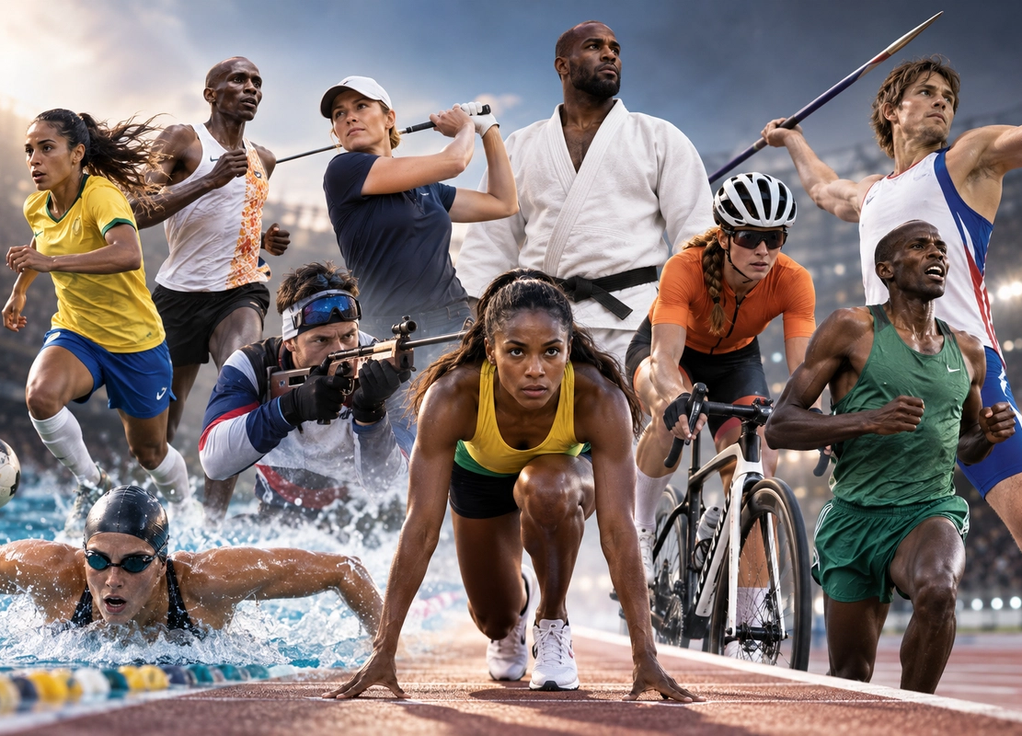
The Underrated Athletes Who Deserve More Credit
Izak Tareb
September 19, 2026
Sports history has a visibility problem. The athletes we remember most clearly are not always the only ones who dominated their eras. They are often the people whose achievements arrived in the right sport, country, media environment, or historical moment to become famous.
For every universally recognized superstar, there are remarkable athletes whose careers never received the same attention. Some competed in less globally popular sports. Others were overshadowed by once-in-a-generation rivals. Some dominated before television and social media could turn them into international celebrities.
Looking beyond the obvious names reveals just how much sporting greatness exists outside the usual highlight reels.
Hicham El Guerrouj made extraordinary speed look normal
Middle-distance running has produced plenty of famous champions, but Morocco’s Hicham El Guerrouj deserves to be discussed more often outside athletics circles.
El Guerrouj dominated the 1,500 meters and mile during an exceptional period of his career. His combination of speed, endurance, and consistency made performances that should have looked astonishing begin to feel almost expected.
His Olympic story made the career even more remarkable. After disappointment earlier in his career, he eventually won Olympic gold in both the 1,500 and 5,000 meters in Athens in 2004.
That combination demonstrated an extraordinary range.
The reason he can feel underrated is partly the nature of track and field. Outside the Olympics and major championships, even historically significant runners often receive much less continuous global attention than stars from major professional team sports.
Marta helped redefine what was possible in women’s soccer
Brazilian soccer history contains some of the most famous athletes ever produced.
Marta belongs in that conversation.
Her dribbling, creativity, finishing, and ability to take control of matches made her one of the defining players of women’s soccer.
Her influence, however, goes beyond individual performances.
Marta became globally visible during a period when women’s club soccer had far less investment, media coverage, and commercial infrastructure than it has today.
That context matters.
Modern stars benefit from increasingly professional leagues, larger audiences, stronger sponsorship ecosystems, and much greater digital visibility.
Marta helped build attention during a period when those systems were still developing.
Her career was not simply successful inside women’s soccer. It helped expand the audience for it.
Ole Einar Bjørndalen dominated a sport many people barely watch
Biathlon combines cross-country skiing with rifle shooting, which creates an unusual athletic challenge.
Competitors need extraordinary cardiovascular endurance while skiing and then must rapidly control their breathing and heart rate enough to shoot accurately.
Norway’s Ole Einar Bjørndalen became one of the sport’s defining figures.
His longevity and success across Olympic and world-level competition made him a giant of winter sport.
Yet athletes such as Bjørndalen illustrate how fame depends heavily on geography.
In countries where biathlon is popular, he is a major sporting figure.
In places where the sport receives little television coverage, many casual sports fans may barely know his name.
The athletic achievement did not change.
The size of the media ecosystem around it did.
Katie Ledecky made dominance look repetitive
Sometimes athletes become underrated in a strange way because they win too often.
American swimmer Katie Ledecky has spent years producing extraordinary performances in distance freestyle events.
When an athlete repeatedly enters major competitions as the person everyone expects to win, victories can begin receiving less emotional attention.
There is less surprise.
But predictability can actually be evidence of greatness.
Maintaining a significant advantage over elite competitors across multiple years requires constant training, adaptation, and execution.
Dominance should not become less impressive simply because audiences become accustomed to seeing it.
When exceptional performance becomes normal, it is worth reminding ourselves that normality is being created by an exceptional athlete.
Eliud Kipchoge changed how people thought about the marathon
Eliud Kipchoge became famous within running, but his broader sporting significance can still be underestimated.
The marathon is an unforgiving event.
Maintaining elite speed across 42.195 kilometers requires an unusual combination of cardiovascular capacity, running economy, pacing, fueling, mental discipline, and durability.
Kipchoge’s performances helped change perceptions about what elite marathon running could look like.
His calm public personality also contrasted with the drama usually associated with sporting superstardom.
Distance running rarely produces the same celebrity culture as soccer or basketball, but achievements do not become less extraordinary simply because they occur on roads rather than inside packed arenas.
Annika Sörenstam deserves a larger place in general sports history
Golf discussions often revolve around a familiar collection of male stars.
Annika Sörenstam’s career deserves equal attention when discussing sustained dominance.
The Swedish golfer combined technical consistency with an intensely analytical approach to improvement. She accumulated major victories and became one of the defining players in women’s golf.
Her influence extended beyond trophies.
Sörenstam helped increase the visibility of elite women’s golf during a period when the commercial gap between men’s and women’s professional sports was even more pronounced.
Like many historically dominant female athletes, her reputation is enormous within her sport but sometimes receives less attention in general conversations about sporting greatness.
Haile Gebrselassie helped define an era of distance running
Before modern marathon stars captured enormous attention, Ethiopia’s Haile Gebrselassie was building one of distance running’s great careers.
He competed successfully across track and road events and became associated with a remarkable era of Ethiopian distance running.
Gebrselassie’s running style could make extraordinary speeds look deceptively comfortable.
That is one of the strange problems with endurance sports.
The athlete does not necessarily appear to be performing an explosive movement. There is no spectacular dunk or 30-meter goal.
The greatness becomes visible through the clock.
Only when you understand the pace do you realize how extraordinary the performance actually is.
Jan Železný turned a technical event into sustained excellence
Javelin throwing receives enormous attention during major athletics championships and then largely disappears from mainstream sports conversation.
That makes it easy to overlook athletes who achieved extraordinary dominance within the event.
Czech thrower Jan Železný combined speed, coordination, technique, and explosive power at a level that made him one of the defining javelin throwers in history.
Throwing events are sometimes misunderstood as simple tests of strength.
They are not.
Elite javelin requires precise sequencing throughout the body. Speed generated during the approach must be transferred through the legs, hips, torso, shoulder, arm, and finally the implement.
Tiny technical differences can dramatically change the result.
Athletes who master that movement deserve more recognition for the complexity of what they are doing.
Marianne Vos has built one of cycling’s most versatile careers
Cycling rewards specialization.
Different riders are suited to different terrains, race formats, and tactical situations.
That makes Marianne Vos particularly interesting.
The Dutch cyclist has succeeded across road racing, cyclocross, and track competition, demonstrating a level of versatility that is unusual even among elite athletes.
Women’s cycling historically received significantly less international coverage than the men’s professional circuit.
That meant performances that would have generated enormous global attention in men’s cycling sometimes reached much smaller audiences.
As women’s cycling receives greater investment and visibility, careers like Vos’s become easier for a wider audience to appreciate.
Teddy Riner made heavyweight judo dominance look routine
Judo is globally practiced and intensely competitive, but its stars rarely achieve the international celebrity of leading soccer, basketball, or tennis players.
France’s Teddy Riner demonstrates how much greatness can hide inside that visibility gap.
Heavyweight judo requires strength, balance, timing, grip fighting, tactical intelligence, explosiveness, and the ability to make decisions almost instantly.
Riner’s sustained success turned him into one of the sport’s defining figures.
His career also demonstrates a recurring pattern.
Athletes from Olympic sports can become enormous national figures while remaining relatively unfamiliar to casual sports fans elsewhere.
Global sporting fame is not distributed according to achievement alone.
Shelly-Ann Fraser-Pryce deserves recognition beyond Olympic cycles
The 100 meters is one of the most recognizable events in sports, yet even its greatest athletes can disappear from mainstream attention between major championships.
Jamaica’s Shelly-Ann Fraser-Pryce built an extraordinary sprinting career through speed, consistency, longevity, and repeated success against changing generations of competitors.
Longevity is particularly difficult in sprinting.
Tiny declines in explosiveness can have enormous competitive consequences when races are decided by fractions of a second.
Remaining competitive across many seasons therefore requires much more than simply maintaining general fitness.
It requires preserving highly specialized physical qualities at an elite level.
Some athletes are underrated because they played beside legends
Greatness can also become hidden by timing.
An exceptional tennis player competing during an era containing several historically dominant champions may finish with fewer major titles than someone of similar ability from another generation.
A brilliant soccer midfielder may spend their career alongside a teammate who scores spectacular goals and receives most of the attention.
A basketball player may become essential to championship teams without ever being the primary scorer.
Statistics need context.
Sometimes an athlete’s career looks less extraordinary only because they happened to compete against—or alongside—someone even more extraordinary.
Team sports systematically reward visible roles
Certain contributions are easier to notice.
Goals are obvious.
Points are obvious.
Home runs are obvious.
Other contributions require more attention.
A defensive midfielder may prevent attacks before they become dangerous. An offensive lineman can perform brilliantly while barely appearing in a football highlight. A basketball defender may change an opponent’s entire strategy without producing a spectacular statistical line.
This creates a natural bias toward athletes whose contributions are easiest to count.
Great teams often depend on players who make everyone around them better without becoming the face of the team.
Their teammates and coaches usually understand their importance long before the public does.
Fame and greatness are not the same measurement
The athletes who dominate sports culture are shaped by many factors beyond performance.
They need visibility.
They may need the right market, personality, language, sponsorship opportunities, rivalries, media coverage, and historical timing.
None of those things are meaningless. Sports are entertainment as well as competition, and cultural influence is a genuine form of significance.
But fame should not become our only way of recognizing excellence.
Some extraordinary athletes competed in sports the world rarely watches.
Others dominated before social media existed.
Some spent careers performing the less glamorous jobs that allowed famous teammates to succeed.
And some were so consistently brilliant that audiences eventually stopped being surprised.
The deeper you look into sports history, the clearer the pattern becomes.
There are far more great athletes than there are famous ones.