The Soccer Rules and Positions Explained (For Casual Fans)
Connor Doyle
September 19, 2026
Soccer can seem almost too simple when you first watch it. Twenty-two players run around a large field, nobody can use their hands, and everyone is trying to put the ball into a goal.
Then someone celebrates a goal that gets disallowed for offside, a referee produces a yellow card, a defender suddenly becomes an attacker, and commentators start talking about false nines, holding midfielders, and wing-backs.
The good news is that you do not need to understand every tactical detail to enjoy soccer.
Once you know the basic rules and what the major positions are trying to accomplish, the game becomes much easier to read.
The basic objective is incredibly simple
Two teams compete to score more goals than their opponent.
Each team normally has 11 players on the field, including one goalkeeper.
A goal counts when the entire ball crosses the goal line between the posts and underneath the crossbar, provided no rule was broken during the attacking move.
Players generally cannot deliberately handle the ball with their hands or arms.
The major exception is the goalkeeper, who can use their hands within their own penalty area, subject to the rules governing goalkeeper possession.
Everyone else primarily controls the ball using their feet, although players can also legally use areas such as the head, chest, and thighs.
A match normally lasts 90 minutes
A standard match consists of two 45-minute halves.
Unlike sports where the clock stops constantly, soccer’s clock generally continues running during interruptions.
The referee therefore adds time at the end of each half to compensate for delays such as injuries, substitutions, goal celebrations, disciplinary incidents, and other interruptions.
This is called added time or stoppage time.
In knockout competitions where a winner must be determined, a tied match may continue into extra time, normally consisting of two additional 15-minute periods.
If the score remains tied after extra time when the competition requires a winner, the match may be decided through a penalty shootout.
The goalkeeper is the last line of defense
The goalkeeper is the easiest position to recognize.
They normally stay closest to their own goal and are the only player allowed to deliberately handle the ball within their own penalty area under normal circumstances.
Their most obvious responsibility is stopping shots.
But modern goalkeepers do much more.
They organize defenders, claim crosses, rush out to intercept passes behind the defensive line, and increasingly participate in passing moves.
Some teams effectively use their goalkeeper as an additional outfield player when building attacks from the back.
That means modern goalkeepers need excellent decision-making and passing ability in addition to traditional shot-stopping skills.
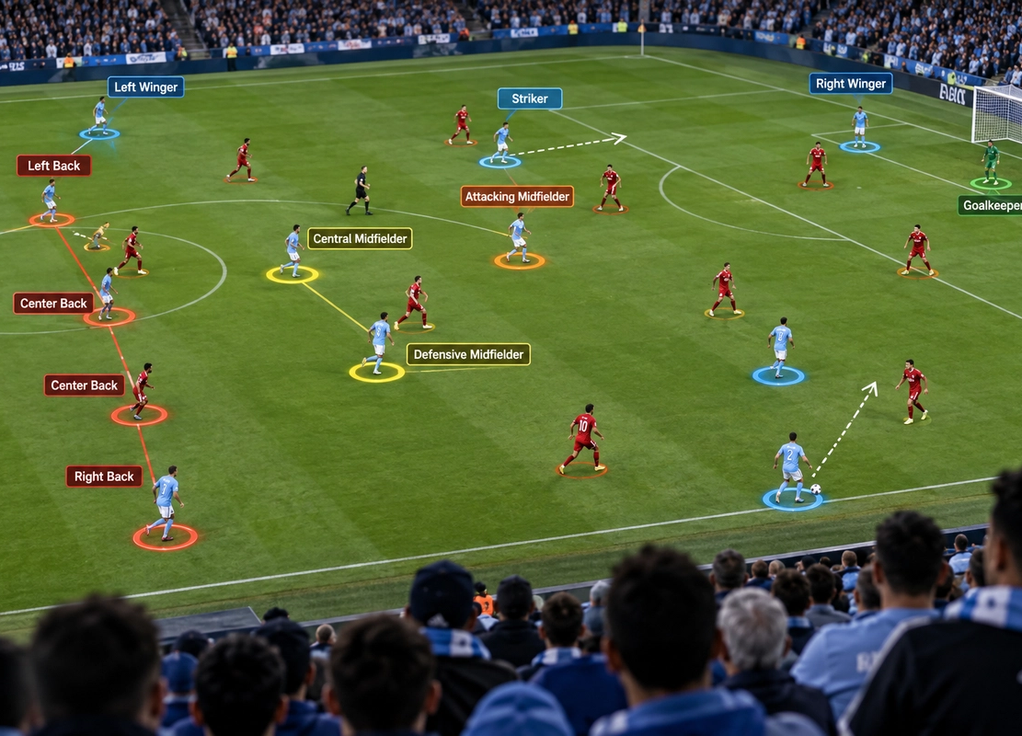
Center-backs protect the middle
Center-backs usually play directly in front of the goalkeeper.
Their primary responsibility is preventing opponents from reaching dangerous central areas.
They challenge attackers, intercept passes, win headers, block shots, and organize the defensive line.
Traditionally, center-backs were often judged primarily by strength, positioning, and tackling.
Modern soccer demands more.
Many teams want defenders who can comfortably receive the ball under pressure and begin attacks with accurate passes.
A great center-back therefore has two jobs: stop the opponent’s attack and help start their own team’s attack.
Full-backs defend the sides
The defenders positioned toward the left and right sides are usually called full-backs.
A left-back plays on the left. A right-back plays on the right.
Their defensive responsibility is often to deal with opposing wingers and prevent crosses or runs from wide positions.
But modern full-backs frequently attack too.
They can run forward, overlap teammates, provide crosses, move into midfield, and help create numerical advantages.
Some systems use wing-backs instead.
Wing-backs generally operate even higher up the field and are expected to contribute heavily to both attack and defense.
This makes wide defensive positions some of the most physically demanding roles in soccer.
Midfielders connect everything
Midfield is where positional terminology starts becoming more complicated because midfielders can perform very different jobs.
A defensive midfielder usually plays deeper and protects the defense. They may intercept passes, win possession, and provide a safe passing option when the team has the ball.
Central midfielders operate throughout the middle of the field, helping move possession between defense and attack.
Attacking midfielders play closer to the forwards and are usually expected to create chances through passing, movement, and combinations around the penalty area.
Some midfielders specialize.
A “number 6” usually refers to a deeper midfielder. A “number 8” often describes a more mobile central midfielder who contributes in multiple areas. A “number 10” traditionally refers to an attacking creator operating behind the forwards.
The exact responsibilities depend heavily on the team’s tactical system.
Wingers attack from wide areas
Wingers generally start on the left or right side of the attack.
Traditionally, their job was to beat defenders near the sideline and deliver crosses toward a central striker.
Modern wingers can be much more varied.
Some stay wide.
Others move inside toward goal, particularly when playing on the opposite side from their stronger foot. A right-footed player starting on the left, for example, can cut inside onto the stronger foot and shoot.
Wingers are often among the quickest and most technically skilled players on a team because they regularly face defenders one-on-one.
Their ability to create something from seemingly harmless positions can completely change matches.
The striker is usually the main goal threat
The striker, sometimes called the center-forward or number 9, generally plays closest to the opposing goal.
Scoring is usually the central expectation.
But strikers can contribute in different ways.
Some are powerful players who hold the ball while teammates move forward. Others specialize in running behind defenders. Some remain near the penalty area waiting for scoring opportunities.
Then there is the “false nine.”
A false nine begins in a position that resembles a traditional striker but frequently moves backward into midfield.
Defenders then face a difficult decision.
If they follow, they may leave space behind them.
If they stay, the false nine may receive the ball freely.
This is one example of how soccer positions increasingly describe responsibilities rather than fixed locations.
Fouls can produce free kicks and cards
Soccer is a contact sport, but not every form of contact is legal.
Actions such as tripping, pushing, kicking, holding, or making certain reckless challenges can result in fouls.
When a foul occurs, the opposing team may receive a free kick.
Some free kicks allow the attacking player to shoot directly at goal. Others require the ball to touch another player before a goal can legally be scored.
Referees can also discipline players with cards.
A yellow card is a formal caution.
Two yellow cards to the same player in one match result in a red card.
A referee can also show a straight red card for certain serious offenses.
A player receiving a red card is sent off, and the team normally continues with one fewer player.
That can dramatically change a match.
Fouls inside the penalty area can produce penalties
The large rectangular area surrounding each goal is called the penalty area.
If the defending team commits certain direct-free-kick offenses inside its own penalty area, the attacking team is awarded a penalty kick.
The ball is placed on the penalty mark.
One attacker takes the kick against the goalkeeper.
Because the distance is short and no defenders can directly challenge the shooter during the kick, penalties produce excellent scoring opportunities.
That is why incidents inside the penalty area receive so much attention.
A single mistimed tackle can completely change a match.
Offside is easier than it sounds
Offside is probably soccer’s most confusing basic rule.
The simplest way to understand it is that attackers generally cannot simply stand behind the opposing defense waiting for someone to pass them the ball.
When a teammate plays the ball toward an attacker, the attacker’s position at that specific moment matters.
In simplified terms, an attacking player can be in an offside position if they are in the opponents’ half and closer to the goal line than both the ball and the second-last opponent.
But simply standing in an offside position is not automatically an offense.
The player must become involved in active play in a way covered by the offside law.
This distinction explains why television broadcasts sometimes show an attacker standing beyond defenders without immediately stopping play.
Formations describe the team’s basic shape
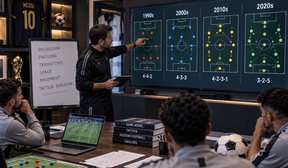
Numbers such as 4-3-3 and 4-2-3-1 describe formations.
A 4-3-3 generally means four defenders, three midfielders, and three forwards, excluding the goalkeeper from the numbering.
A 4-2-3-1 describes four defenders, two deeper midfielders, three more advanced attacking midfielders or wide players, and one striker.
But formations are starting points rather than rigid structures.
A team listed as 4-3-3 might defend in one shape and attack in another.
A full-back may move into midfield. A winger may become a second striker. A midfielder may drop between the center-backs.
That movement is a huge part of modern soccer tactics.
The easiest way to watch is to follow space
New fans naturally follow the ball constantly.
That is useful at first, but eventually try watching the players around it.
Notice how defenders move together when the opponent attacks. Watch midfielders move into empty spaces before receiving passes. Look at attackers making runs even when they never receive the ball.
Those movements explain why certain passes become available.
Soccer is ultimately a game about controlling space.
The team with the ball tries to create it. The defending team tries to remove it.
Once you begin noticing that battle, soccer stops looking like 22 people randomly chasing a ball.
You start seeing the structure underneath everything—and that is usually when the sport becomes much more interesting.