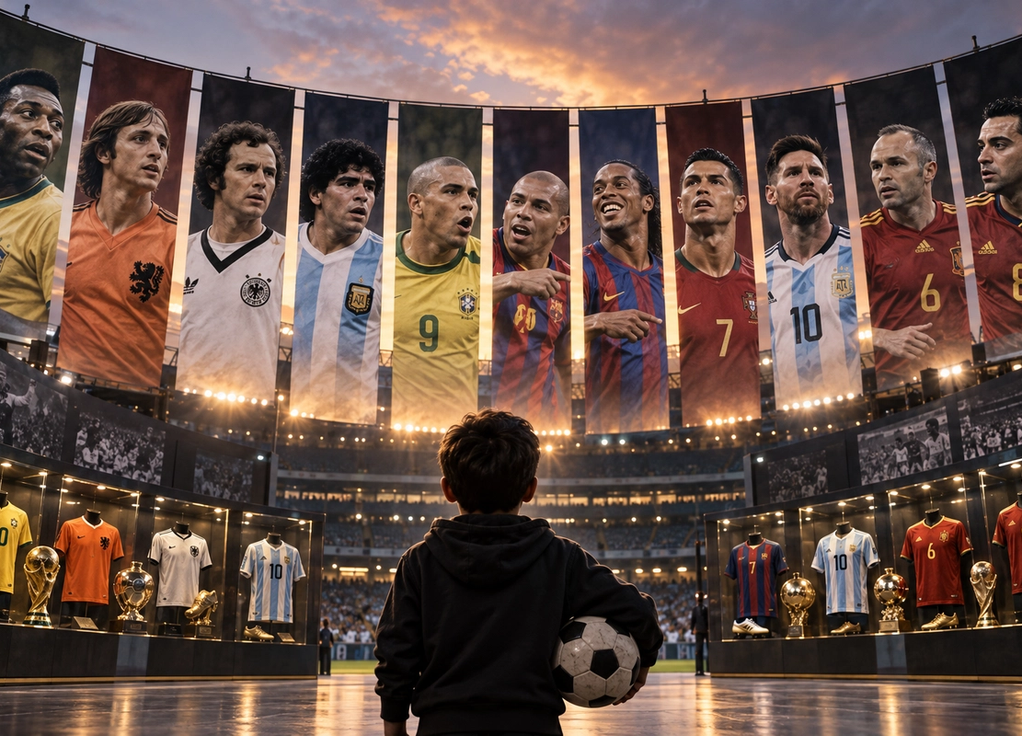
The Soccer Players Who Actually Changed the Global Game
Jaimie Lee
September 19, 2026
Soccer has produced thousands of extraordinary players, but only a smaller group genuinely changed what people believed was possible on a football field. Some introduced new ways of playing. Others transformed a position, carried the sport into new markets, became symbols of entire countries, or inspired generations of players to imitate them.
That distinction matters.
Being one of the greatest players ever does not automatically mean someone changed the game. Influence is about what happened afterward. Did coaches rethink tactics? Did young players copy the technique? Did clubs start searching for a different type of player? Did the sport reach people who had previously paid little attention?
From Pelé to Lionel Messi and Cristiano Ronaldo, soccer’s history can partly be understood through the players who forced the game to evolve around them.
Pelé helped turn soccer into a global spectacle
Pelé became much more than Brazil’s greatest sporting icon. He helped demonstrate the enormous international potential of soccer itself.
His performances for Brazil, particularly on the World Cup stage, introduced millions of people to a style of football associated with creativity, technique, improvisation, and attacking freedom.
Pelé could score, create, dribble, pass, and dominate physically. He did not fit neatly into one modern positional category.
But his wider influence was cultural.
He became one of the first soccer players whose fame genuinely crossed continents. Even people with limited knowledge of the sport knew his name.
Pelé helped establish the template for the global football superstar.
Johan Cruyff changed how players understood space
Johan Cruyff’s influence is difficult to separate from the broader philosophy of Dutch “Total Football.”
The central idea was that positions did not need to be rigid.
Players could move into different areas while teammates adjusted around them. A defender could advance. An attacker could drop deeper. The team maintained its structure through intelligent movement rather than everyone remaining in predetermined locations.
Cruyff became the most famous player associated with this philosophy.
His intelligence, movement, technical quality, and understanding of space made him different from a traditional forward.
His influence later became even greater through coaching, particularly at Barcelona.
Modern positional football owes an enormous intellectual debt to ideas Cruyff helped embody and spread.
Franz Beckenbauer transformed the image of a defender
Defenders were traditionally expected to stop attacks.
Franz Beckenbauer demonstrated that a defensive player could also control a match.
Playing as a sweeper, or libero, Beckenbauer operated behind the defensive line but regularly moved forward with the ball and participated in attacks.
He was elegant rather than purely destructive.
Instead of simply winning possession and immediately giving it to a midfielder, he could carry the ball forward, pass intelligently, and dictate play from deep positions.
That idea feels familiar today because modern center-backs are routinely expected to participate in possession.
During Beckenbauer’s era, it was far more distinctive.
He helped expand the imagination of what a defender could be.
Diego Maradona showed how one player could control an entire tournament
Diego Maradona combined extraordinary technical ability with an almost unmatched capacity to become the center of a team’s attack.
His low center of gravity, close control, acceleration, passing, and creativity allowed him to move through spaces that appeared unavailable.
The 1986 World Cup became the defining example.
Maradona’s performances for Argentina demonstrated how an individual player could dominate the narrative of an entire tournament.
His influence was especially powerful because his football felt improvisational.
Young players did not simply want to score like Maradona.
They wanted to dribble like him, move like him, and play with the same sense of freedom.
He helped reinforce the idea of the number 10 as soccer’s creative genius—the player given unusual freedom because he could decide matches.
Ronaldo Nazário redefined the modern striker
Before injuries changed the trajectory of his career, Brazilian striker Ronaldo appeared to combine qualities that were rarely found in one forward.
He had the explosive speed of a winger, the strength of a center-forward, extraordinary dribbling ability, and elite finishing.
Defenders faced a terrible choice.
Give him space and he could accelerate past them. Get close and he could beat them with technique. Allow him into the penalty area and he could finish.
Ronaldo helped redefine expectations for elite strikers.
The position did not have to belong exclusively to physically imposing penalty-box forwards.
A striker could collect the ball deeper, attack defenders directly, create his own opportunities, and still score at an extraordinary rate.
Many of the complete forwards who followed were measured against that template.
Zinedine Zidane made control itself feel dominant
Zinedine Zidane’s influence was less about reinventing a specific position and more about demonstrating how technical control could dictate the emotional pace of a match.
Zidane rarely looked rushed.
His first touch allowed him to escape pressure. His awareness helped him find spaces before opponents recognized them. His turns and changes of direction could transform defensive situations into attacks.
For a generation of midfielders, Zidane represented elegance under pressure.
His influence can be seen in the continuing obsession with midfielders who can receive the ball in crowded spaces and somehow create time for themselves.
The lesson was simple: speed in soccer does not always mean running faster.
Sometimes it means understanding the situation earlier.
Ronaldinho made creativity globally fashionable again
Few players made soccer look as joyful as Ronaldinho.
His tricks, no-look passes, dribbles, free kicks, and improvisation turned matches into entertainment beyond the score.
Street-football techniques appeared on the biggest stages without apology.
That mattered culturally.
A generation of young players watched Ronaldinho and saw creativity not as unnecessary showmanship but as a legitimate way to dominate elite opponents.
His peak was relatively short compared with some other all-time greats, but his cultural influence was enormous.
You can see it in highlight culture, freestyle soccer, social media clips, and the attacking players who grew up believing that effectiveness and entertainment did not have to be separate things.
Cristiano Ronaldo transformed the model of the modern superstar
Cristiano Ronaldo’s career became a case study in adaptation.
He began as an explosive winger known for dribbling, tricks, and acceleration. Over time, he evolved into one of soccer’s most productive goalscorers.
His movement became more efficient. His positioning improved. He became devastating in the air and increasingly focused his game around actions that produced goals.
Ronaldo also influenced soccer away from matches.
His approach to physical preparation, recovery, training, personal branding, and longevity became part of the modern superstar template.
Elite players had always trained seriously.
Ronaldo helped turn extreme physical optimization into part of a footballer’s public identity.
Lionel Messi changed what teams thought a playmaker could be
Lionel Messi created a positional problem that teams spent years trying to solve.
Was he a winger?
A number 10?
A striker?
A false nine?
The answer was often all of them.
Messi combined elite dribbling, passing, vision, finishing, and movement in a way that made traditional positional labels feel inadequate.
At Barcelona, his use as a false nine became particularly influential. Instead of remaining between the opposing center-backs, Messi could move into midfield, receive possession, and force defenders to decide whether to follow him.
Following created space behind them.
Staying deep gave Messi room to turn.
Modern soccer’s obsession with fluid attacking positions owes something to the tactical problems players like Messi created.
Andrés Iniesta and Xavi changed how midfield dominance was understood
Not every revolutionary player dominates through goals.
Xavi Hernández and Andrés Iniesta became symbols of a different kind of control.
Their Barcelona and Spain teams demonstrated how possession could become both an attacking strategy and a defensive mechanism.
If your opponent cannot get the ball, it becomes very difficult for them to attack.
Xavi controlled rhythm through positioning and passing. Iniesta could escape pressure through movement, touch, and dribbling.
Together, they helped make midfield intelligence one of the defining obsessions of modern coaching.
Their influence can be seen in academies around the world teaching young players to scan before receiving, create passing angles, and remain comfortable under pressure.
The most influential players change what comes next
Soccer constantly absorbs its greatest players.
Pelé helped globalize the superstar. Cruyff transformed thinking about space and movement. Beckenbauer expanded the role of defenders. Maradona elevated the free creative genius. Ronaldo Nazário changed expectations for strikers. Ronaldinho celebrated improvisation. Cristiano Ronaldo demonstrated extraordinary adaptation and physical optimization. Messi blurred attacking positions. Xavi and Iniesta showed how possession could control entire matches.
Then coaches and players copied what worked.
That is how soccer evolves.
The truly influential player does not simply leave behind goals, trophies, or famous highlights.
He leaves behind ideas.
And years after that player is gone, you can still see those ideas every weekend in someone else’s game.