The Real Difference Between College and Pro Basketball
Jade josef
September 19, 2026
At first glance, college basketball and professional basketball seem almost identical. The court looks familiar, both teams have five players, and the basic objective is exactly the same: put the ball in the basket more often than the opponent.
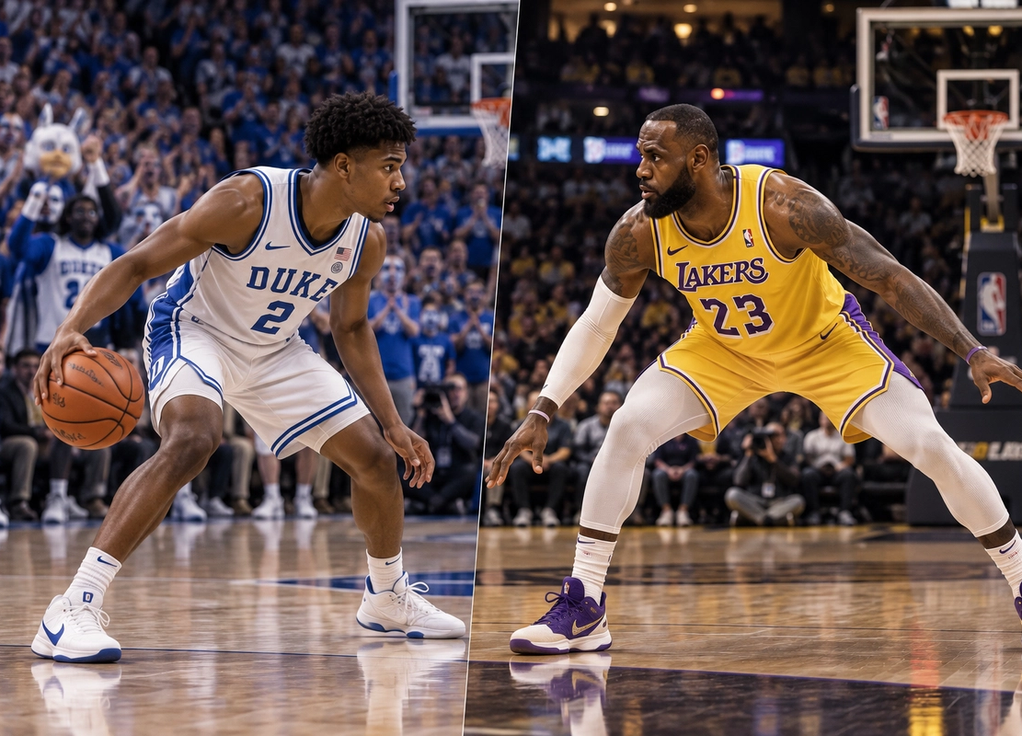
Watch a college game and an NBA game back-to-back, however, and they can feel like two different versions of the sport. The differences go far beyond the fact that NBA players are older, more experienced, and paid professionally. Rules, game length, tactics, spacing, schedules, player development, and even the atmosphere surrounding the games all shape how basketball is played.
Understanding those differences also explains why a brilliant college player does not automatically become a brilliant professional—and why some players actually look better once they reach the NBA.
The players are operating at a different level
The most obvious difference is the overall level of talent.
College basketball includes outstanding athletes, but the NBA brings together a tiny percentage of the world’s best players. Someone who was the dominant scorer, rebounder, or defender on a college team may suddenly find himself competing against players who are equally athletic, significantly stronger, and far more experienced.
That changes everything.
A driving lane that stayed open long enough for a college guard to reach the basket might disappear almost immediately in the NBA. A shot that seemed uncontested in college may be challenged by a longer, faster defender. Centers who could dominate opponents physically in college encounter NBA players capable of matching their size and strength.
The game therefore demands faster decisions. Professional players often have only fractions of a second to decide whether to shoot, pass, drive, or reset the offense.
The rules create different games
College and NBA basketball also operate under different rules.
One of the clearest differences is game length. NCAA men’s basketball is played in two 20-minute halves, while an NBA game consists of four 12-minute quarters. The NBA therefore has eight additional minutes of regulation basketball.
The shot clocks differ as well. NCAA men’s teams generally have 30 seconds to attempt a shot, compared with 24 seconds in the NBA. Those six seconds might not sound significant, but they affect the rhythm of the game.
NBA teams are pushed into actions more quickly. They have less time to hold the ball, patiently reset an offense, or wait for something to develop.
The three-point lines also differ, with the NBA line generally farther from the basket. Other rules concerning fouls, defensive positioning, timeouts, and game administration create additional differences.
Individually, these rules may seem small. Together, they produce noticeably different styles of basketball.
NBA spacing changes almost everything
One of the biggest differences casual fans may not immediately notice is spacing.
NBA players generally shoot from greater distances with much higher consistency. Defenders therefore cannot simply ignore a player standing far from the basket. If they move too far away from a capable shooter, they risk giving up an open three-pointer.
That stretches the defense across the court.
More spacing creates driving lanes, opportunities for passes, and room for offensive stars to operate. It is one reason some players who struggled with crowded defenses in college can become more effective professionals.
College teams can sometimes pack defenders closer to the basket because certain opponents are less dangerous shooters. That can make the court appear more congested and force offenses to rely on structured movement to create openings.
The dimensions of the court may look similar on television, but the usable space can feel dramatically different.
College basketball can be more system-driven
College coaches often have enormous influence over how their teams play.
Because individual talent varies widely between programs, coaches may design systems specifically around the strengths and weaknesses of their roster. Some teams play extremely fast. Others deliberately slow the game down. Some depend heavily on three-point shooting, while others emphasize defense, rebounding, or interior scoring.
The NBA certainly has sophisticated coaching and complex systems, but individual players have more ability to influence possessions.
When a team has an elite professional scorer, sometimes the best strategy really is to give that player the ball and create enough space for him to attack.
NBA offenses also make extensive use of pick-and-rolls, switches, screens, mismatches, and isolation opportunities. Because the players are so skilled, a small defensive mistake can immediately become an open shot.
The schedules create different challenges
College and professional seasons demand different types of endurance.
An NBA regular season contains 82 games for each team, creating months of travel, back-to-back games, injuries, fatigue, and constant adjustments. Managing a professional roster is partly about surviving that schedule while remaining healthy enough for the postseason.
College teams play significantly fewer games.
That gives individual matchups a different weight, particularly during conference play and postseason tournaments. A short losing streak can dramatically affect a team’s season.
The NCAA tournament takes this pressure to another level. It is a single-elimination competition: lose once and the season is over. That format creates the possibility of dramatic upsets.
The NBA playoffs use best-of-seven series. A weaker team cannot simply produce one incredible night. It generally has to defeat the same opponent four times, while both coaching staffs continuously adjust their strategies.
Player development works differently
College basketball is partly a developmental environment. Players arrive at different stages of physical and technical maturity, and coaches are responsible for helping them improve while simultaneously trying to win.
Professional basketball assumes a much higher starting level.
NBA players still develop significantly, but organizations are refining athletes who have already reached an exceptional standard. Teams employ specialized coaches, medical staff, performance experts, analysts, and development personnel to improve specific parts of a player’s game.
The transition can still be difficult.
A college star may become a role player because NBA teams no longer need him to take 20 shots per game. He might instead be asked to defend, rebound, set screens, or make open three-pointers.
Learning to succeed with fewer opportunities can be as important as improving technically.
The atmosphere is completely different
This is one area where “professional” does not automatically mean bigger or better.
NBA arenas can be spectacular, especially during major playoff games. But college basketball has its own kind of intensity.
Student sections, school traditions, historic rivalries, marching bands, smaller arenas, and generations of alumni can create remarkably emotional environments. Some college rivalries are tied to communities and universities that have competed for decades.
The NBA atmosphere is more closely connected to professional franchises, superstar players, championships, and city identity.
Neither experience is necessarily superior. They simply produce different versions of basketball culture.
Why being great in college does not guarantee NBA success
The gap between the two levels explains one of basketball’s most interesting realities: college success is not a perfect predictor of professional success.
NBA teams are not only asking how good a player is today. They are trying to determine whether his skills will translate against bigger, faster, and more technically advanced opponents.
Can he defend multiple positions? Can he shoot from NBA range? Can he make decisions quickly? Can he contribute without constantly having the ball?
Sometimes the answers are surprising.
A dominant college player may struggle professionally, while a less celebrated college player may possess exactly the combination of shooting, defense, athleticism, and decision-making that NBA teams need.
That is the real difference between college and pro basketball. The fundamentals remain the same, but the speed, space, talent, rules, pressure, and expectations change. It is still basketball—just played under very different conditions.