The Fundamentals of Basketball Every Casual Fan Should Know
Connor Doyle
September 19, 2026
Basketball can look complicated when you first start watching it. Players move constantly, substitutions happen quickly, referees make calls that are not always obvious, and commentators casually use terms like “pick-and-roll,” “fast break,” and “shot clock.” But underneath all that movement, basketball is actually a fairly straightforward game. Once you understand a few basic rules and concepts, it becomes much easier—and much more entertaining—to follow.
You do not need to memorize every statistic or know the entire roster of an NBA team to enjoy basketball. Understanding how scoring works, what players are trying to accomplish, and why certain moments matter is enough to turn a confusing game into one that makes sense.
How scoring works
The basic objective of basketball is simple: score more points than the opposing team by putting the ball through their basket while preventing them from doing the same.
Most baskets are worth two points. If a player shoots from behind the three-point line and makes the shot, the team receives three points. Free throws, which are awarded after certain fouls, are worth one point each.
The three-point line has become especially important in modern basketball. Teams increasingly look for efficient three-point opportunities because making a reasonable percentage of them can produce more points than relying entirely on two-point shots. However, shots close to the basket remain extremely valuable because they are generally easier to make.
A basketball game is therefore a constant balance between finding high-quality shots and stopping the opponent from getting them.
The basic structure of a game
Two teams compete with five players from each team on the court at a time. Teams can substitute players throughout the game, which allows coaches to manage fatigue, injuries, defensive matchups, and different tactical situations.
Game length depends on the competition. NBA games consist of four 12-minute quarters, while many other leagues use different formats. If the score is tied at the end of regulation, the teams play overtime periods until there is a winner.
One important thing for new fans to understand is that the final few minutes of a close basketball game can take much longer than the game clock suggests. Coaches use timeouts, players intentionally commit fouls, referees review plays, and teams carefully manage each possession. Thirty seconds on the clock can sometimes contain several minutes of real-world drama.
Understanding possessions and the shot clock
Basketball becomes much easier to follow once you start thinking in terms of possessions. A possession is essentially one team’s opportunity to attack and score. It usually ends when the team scores, turns the ball over, or misses a shot and the opponent collects the rebound.
Teams cannot simply hold the ball indefinitely. In the NBA, the offensive team normally has 24 seconds to attempt a shot. This is known as the shot clock. If the team fails to attempt a valid shot before the clock expires, possession goes to the opponent.
The shot clock creates urgency. A team may patiently move the ball early in a possession, but when only a few seconds remain, someone usually has to create a shot quickly.
Possessions also explain why turnovers matter so much. Losing the ball without taking a shot gives away a scoring opportunity while creating one for the opponent.
The five traditional positions
Basketball traditionally divides players into five positions: point guard, shooting guard, small forward, power forward, and center.
The point guard typically organizes the offense and handles the ball frequently. Shooting guards are often strong outside shooters and scorers. Small forwards tend to be versatile players who can score and defend in several ways. Power forwards traditionally play closer to the basket and contribute through rebounding and physical play, while centers are usually larger players who protect the rim, rebound, and score near the basket.
Modern basketball has made these categories much less rigid. A tall player might handle the ball like a guard, while a center might regularly shoot three-pointers. Coaches increasingly value players who can perform several roles.
For casual fans, it is more useful to watch what a player actually does than to worry too much about the position listed beside their name.
Fouls, free throws, and turnovers
A foul occurs when a player makes illegal physical contact with an opponent or violates certain rules of play. Common examples include hitting a shooter’s arm, pushing an opponent, or making excessive contact while defending.
Depending on the situation, a foul may result in the opposing team receiving the ball or shooting free throws. When a player is fouled while shooting, they can often receive two or three free throws depending on where the shot was attempted. A player can also eventually be removed from the game after accumulating too many personal fouls.
Turnovers are different. They happen when a team loses possession without a successful shot. Traveling, stepping out of bounds, throwing a bad pass, committing certain offensive fouls, or having the ball stolen can all create turnovers.
Rebounds and why they matter
When a shot misses, players compete for the rebound. A defensive rebound occurs when the defending team collects the ball and gains possession. An offensive rebound happens when the attacking team retrieves its own missed shot.
Offensive rebounds can be particularly damaging because they give a team another opportunity to score after the defense has already forced a miss. They can also lead to easier shots because defenders may be out of position.
This is why you will often see players fighting intensely for space underneath the basket before a shot even reaches the rim.
The basic offensive actions you will see constantly
Basketball offenses use countless strategies, but casual fans only need to recognize a few common actions.
One of the most important is the pick-and-roll. One offensive player sets a screen, or “pick,” to block a defender’s path. The ball handler uses that screen and moves toward the basket while the player who set it can “roll” toward the rim. The defense must quickly decide how to cover both players.
Another common concept is the fast break. Instead of slowly setting up an offense, a team attacks immediately after gaining possession, hoping to score before the opposing defense gets organized.
Teams also constantly use passing, cutting, screens, and off-ball movement to create open shots.
What makes a team good
Scoring gets most of the attention, but strong basketball teams usually succeed in several areas at once. They create efficient shots, avoid unnecessary turnovers, rebound consistently, defend without committing excessive fouls, and communicate well.
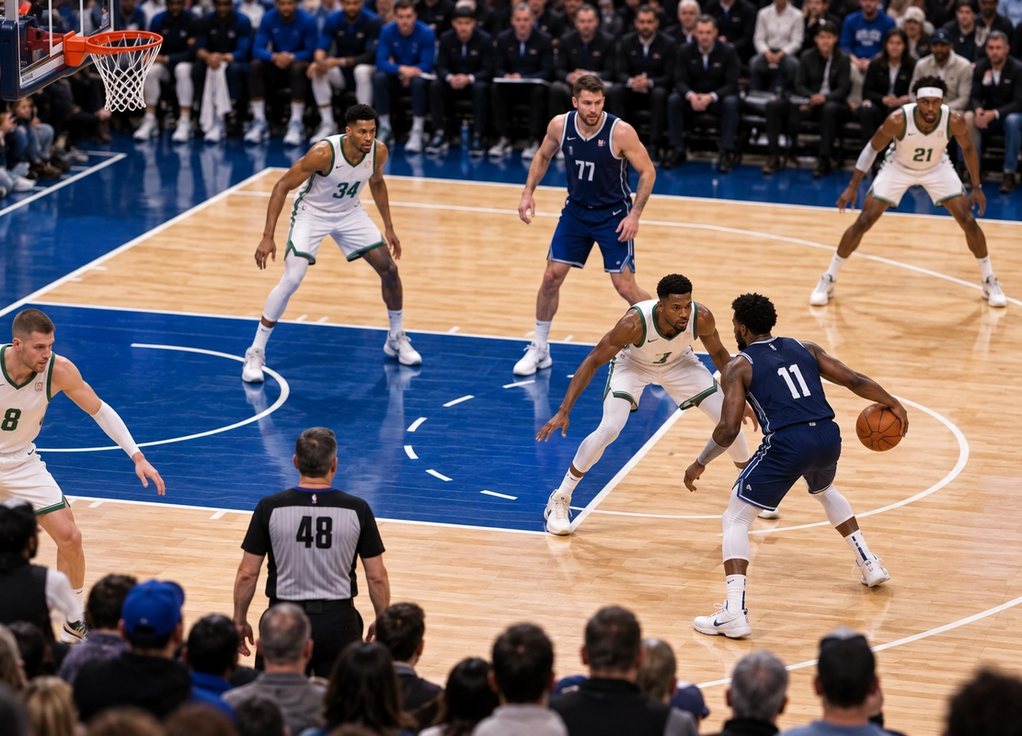
Great teams also understand spacing. By spreading offensive players around the court, they force defenders to cover more territory. That creates room for drives to the basket, passes, and open three-point attempts.
Once you start noticing these details, basketball changes as a viewing experience. Instead of simply watching the player holding the ball, you begin watching screens, defensive rotations, movement away from the ball, and the decisions that create the eventual shot.
That is really the point where a casual fan starts seeing the game rather than just seeing the ball.