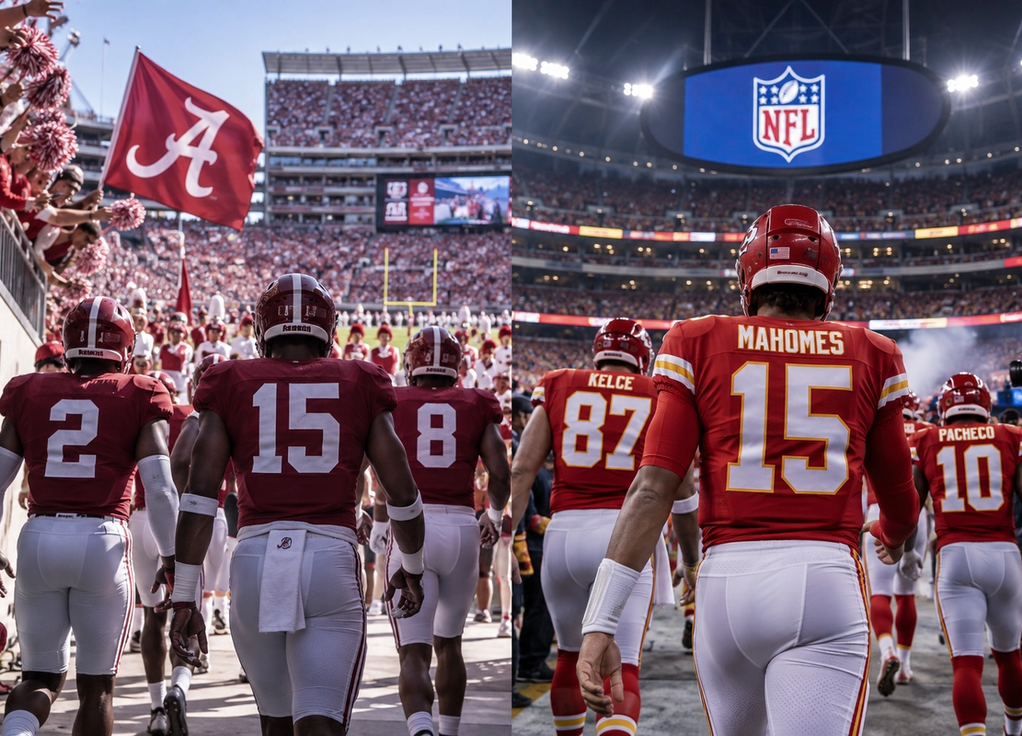
The Difference Between College Football and the NFL (Beyond the Rules)
Jade josef
September 19, 2026
College football and the NFL share the same basic objective, many of the same positions, and much of the same football language. Yet watching a major college game on Saturday and an NFL game on Sunday can feel surprisingly different.
Some of that comes from actual rule differences, but the bigger distinction is structural. College football involves young players representing universities, enormous differences in talent between programs, constant roster turnover, recruiting, campus traditions, and regional rivalries. The NFL consists of 32 professional franchises filled with players who have already survived an extremely competitive selection process.
The result is two versions of football with different cultures, strategies, levels of parity, and definitions of success.
The talent gap changes everything
The NFL is incredibly selective.
Thousands of athletes play college football, but only a small percentage become NFL players. Someone who looks average in the NFL may have been one of the best players on his college team.
That concentration of talent changes the professional game.
NFL defenders are generally faster, stronger, and more technically developed. Passing windows become smaller. Quarterbacks have less time to make decisions. Running backs find fewer obvious openings. Receivers who could simply outrun college defenders may discover that professional cornerbacks can match their speed.
College football contains elite athletes too, including future NFL stars. The difference is that talent is distributed much less evenly.
A national powerhouse may have future professional players across its roster while a smaller opponent has very few. That can produce enormous mismatches that rarely exist at the NFL level.
College teams can have completely different identities
Because college rosters vary so much, the sport contains an enormous range of playing styles.
One program may build its offense around a mobile quarterback. Another might rely on a powerful running game. Another could spread receivers across the field and throw constantly.
Coaches can design systems around the particular athletes they are able to recruit.
The NFL has strategic variety too, but professional teams operate within a narrower range because defenders are so talented. A system built entirely around exploiting slower or weaker opponents becomes much harder to sustain when almost every defender is an exceptional athlete.
College football can therefore feel more experimental.
Unusual formations, option offenses, aggressive trick plays, and dramatic stylistic differences between teams are more common.
This is part of what makes the college game unpredictable. Teams are not simply different in quality; they can look as if they have completely different ideas about how football should be played.
Recruiting is college football’s version of roster building
NFL teams acquire players through the draft, trades, and free agency. College programs traditionally build their rosters primarily through recruiting, while the transfer system has become increasingly important.
Recruiting is one of the defining forces in college football.
Coaches are not simply responsible for developing players and designing game plans. They also have to convince talented young athletes to choose their program.
A coach’s reputation, facilities, playing opportunities, program history, location, relationships, and potential pathway toward professional football can all influence those decisions.
The modern transfer environment has added another layer. Players can change schools under applicable eligibility rules, giving programs additional ways to strengthen their rosters and giving athletes greater ability to seek new opportunities.
College roster construction therefore never really stops.
The NFL is built around competitive balance
Professional football deliberately contains mechanisms intended to prevent successful teams from simply collecting unlimited talent.
The salary cap limits spending. The draft generally gives weaker teams earlier access to incoming players. Scheduling and other league structures also contribute to an environment where franchises can improve relatively quickly.
College football does not have the same traditional structure of competitive balance.
Historically successful programs can use their reputation, resources, coaching, facilities, and recruiting networks to attract more elite players. Winning can help produce better recruiting, and better recruiting can produce more winning.
That creates powerful cycles.
College football has consequently featured programs that remain nationally relevant across long periods, although coaching changes, conference movement, transfers, and changes in the economics of college sports can quickly alter the landscape.
The NFL tends to produce more parity. Going from terrible to competitive in a relatively short period is entirely possible if a franchise makes several excellent decisions.
Player development means something different
College football occupies an unusual position between youth sports and professional competition.
Many college players arrive physically and technically unfinished. Over several seasons, they may become stronger, learn more sophisticated systems, improve their technique, and develop into professional prospects.
That makes development central to college coaching.
NFL teams also develop players, but the starting point is much higher. A rookie entering professional football has already competed against other high-level college athletes and passed through extensive scouting and evaluation.
The professional question is less likely to be, “Can this person become a good football player?” and more likely to be, “Can his skills work against NFL competition?”
That distinction explains why dominating college football does not guarantee professional success.
Some college stars benefit from physical advantages that disappear in the NFL. Others play in systems that hide weaknesses professional defenses can expose.
The atmosphere is fundamentally different
This may be the biggest difference that statistics cannot capture.
College football is deeply connected to universities, alumni, local communities, and regional identity.
Many rivalries existed long before the current players—or even their parents—were born. Stadium traditions are passed from one generation of students to another. Marching bands, fight songs, student sections, tailgating, and campus rituals create an atmosphere that professional football cannot exactly reproduce.
NFL fandom can be equally passionate, but the identity is different.
Professional teams represent cities and regions rather than universities. The experience is centered around franchises, professional stars, playoff races, and the pursuit of the Super Bowl.
College football often feels more chaotic and emotional because the institutions themselves carry histories beyond sports.
A rivalry game can matter enormously even when neither team is competing for a national championship.
Mistakes have different consequences
NFL players are professionals, so execution is generally more consistent.
That does not mean NFL games are mistake-free. Far from it. But the baseline level of preparation and ability is extraordinarily high.
College games can contain more dramatic swings.
A young quarterback may play brilliantly for three quarters and then make a disastrous decision. Special teams mistakes, missed tackles, blown coverages, and emotional momentum can completely transform a game.
That unpredictability is part of college football’s appeal.
In the NFL, teams are often separated by small margins. One failed third down or one turnover can decide a close game because both teams are capable of punishing mistakes.
College football can produce both tightly contested classics and overwhelming blowouts.
Coaches have different kinds of power
College head coaches traditionally influence far more than game-day strategy.
They help shape recruiting, player development, program culture, staffing, and the overall identity of the football operation. The biggest college coaches can become almost inseparable from the universities they represent.
NFL coaches work within a more clearly professional structure.
General managers and front offices typically have major responsibility for contracts, draft decisions, and roster construction, although the exact division of power varies between franchises.
Professional players also have established careers and contractual leverage that college athletes historically did not possess in the same way.
The NFL coach is managing professionals. The college coach is managing a constantly changing program.
Saturday and Sunday offer different versions of football
Trying to decide whether college football or the NFL is “better” misses what makes each interesting.
The NFL offers the highest concentration of football talent in the world. The game is faster, margins are smaller, and strategy becomes extraordinarily sophisticated because weaknesses are quickly punished.
College football offers greater variety.
There are more teams, more dramatic talent differences, more distinct systems, younger players, historic rivalries, and traditions that extend far beyond the field.
The rules certainly separate college football from the NFL, but they are not the main reason the two feel different.
One is a professional league designed around elite competition and relative parity. The other is a huge, constantly changing ecosystem of universities, traditions, recruiting, development, and regional identity.
The field may look almost the same. Everything surrounding it is different.