The Coaches Who Actually Changed How Football Is Played
Rohan Pierce
September 19, 2026
Football history is usually told through players. Quarterbacks throw the famous touchdowns, receivers make the spectacular catches, and defenders deliver the game-changing stops. But many of the biggest changes in football began somewhere less visible: inside a coach’s playbook.
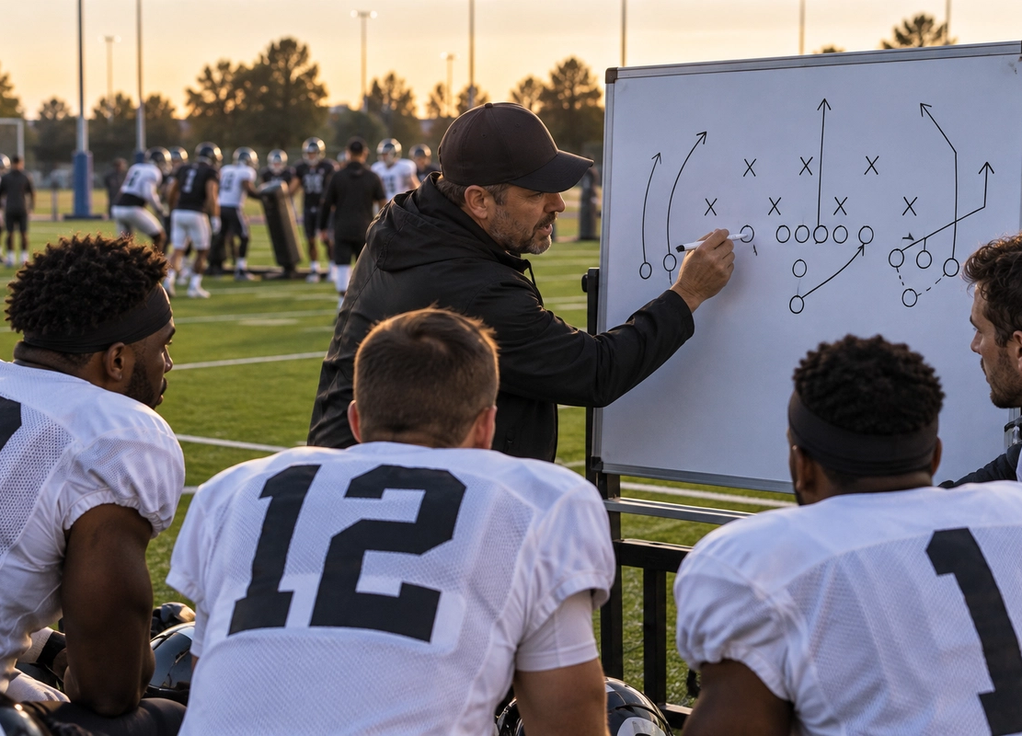
Great coaches do more than win games. Some introduce formations that opponents have never seen, redesign passing systems, invent new defensive concepts, or discover completely different ways to use players. Once those ideas succeed, everyone starts copying them.
Eventually, the innovation becomes so normal that fans forget somebody had to invent it.
From the earliest formations to today’s motion-heavy offenses, a relatively small group of coaches helped transform what American football looks like.
Pop Warner helped create the early tactical game
Glenn “Pop” Warner coached during a period when football looked dramatically different from the modern sport.
One of his most influential contributions was the single-wing offense, a system that used unusual formations, direct snaps, deception, blocking, and multiple potential ball carriers to confuse defenses.
Today, many of its concepts would look strangely familiar.
Modern teams frequently use direct snaps to running backs, option plays, misdirection, and formations designed to make defenders hesitate. The terminology has changed, and the athletes are dramatically different, but the basic strategic idea remains powerful: make the defense uncertain about who has the ball and where the play is going.
Warner helped establish football as a game of deception rather than simply physical force.
Paul Brown modernized coaching itself
Paul Brown’s influence reaches far beyond one offensive or defensive system.
He helped professionalize how football teams prepared.
Brown was an early adopter of extensive film study and systematic scouting. He used detailed playbooks, organized coaching staffs, and increasingly sophisticated methods for communicating plays and preparing players.
Many practices that now seem completely ordinary were once innovative.
His teams approached football as something that could be studied, organized, and improved through preparation rather than relying mainly on toughness and instinct.
Brown’s influence also extended through the coaches who learned from him.
In many ways, he helped establish the model of the modern football organization: specialized coaches, detailed preparation, carefully designed systems, and constant analysis.
Sid Gillman made the entire field available to the passing game
Passing existed long before Sid Gillman, but Gillman thought about it differently.
Rather than treating the forward pass primarily as an occasional alternative to running, he developed offenses designed to attack defenses vertically and horizontally.
Receiver spacing became crucial.
Gillman’s concepts forced defenders to cover larger areas of the field. Instead of placing several receivers near one another, an offense could spread them across different levels and make defenders choose which threats to prioritize.
His influence spread through an extraordinary coaching tree.
Many later passing systems can trace important concepts back to Gillman’s ideas about timing, spacing, routes, and attacking every part of the field.
Modern football’s obsession with creating space did not begin with analytics. Coaches like Gillman were thinking about the geometry of offense decades earlier.
Bill Walsh turned timing into an offensive weapon
Bill Walsh became synonymous with the West Coast offense while coaching the San Francisco 49ers.
Traditional passing attacks often emphasized throwing farther downfield. Walsh demonstrated how devastating an offense could become by using short, accurate passes as an extension of the running game.
The quarterback did not always need to hold the ball and wait for something dramatic.
Instead, receivers could run precisely timed routes. The quarterback could make quick decisions and deliver accurate passes that allowed receivers to gain additional yards after the catch.
Timing was everything.
The quarterback’s footwork, the receiver’s route, and the design of the play were synchronized so the ball could leave the quarterback’s hand quickly.
Walsh’s system influenced generations of NFL offenses. Short passing, scripted opening sequences, yards after catch, and precisely designed route combinations remain fundamental parts of modern football.
Don Coryell pushed passing attacks vertically
While Walsh became associated with controlled, timing-based passing, Don Coryell became famous for aggressively attacking defenses downfield.
His “Air Coryell” system stretched defenses vertically.
Receivers ran deeper routes, quarterbacks looked for explosive plays, and tight ends became more significant receiving threats. Coryell demonstrated that passing could become the central identity of an offense rather than something primarily used when running failed.
That may sound obvious today.
It was far less obvious when NFL football was still heavily oriented around running.
Coryell’s ideas influenced countless offensive coaches and helped create the conceptual foundation for modern vertical passing games.
Every time an offense forces a safety to defend deep while another receiver attacks the space underneath, you can see traces of ideas that Coryell helped popularize.
Buddy Ryan made defense aggressively unpredictable
Offensive coaches were not the only innovators.
Buddy Ryan became famous for aggressive defensive football, particularly the “46 defense” associated with the dominant 1985 Chicago Bears.
The system crowded defenders near the line of scrimmage and created enormous pressure on offenses.
Instead of waiting for the offense to reveal its intentions, Ryan wanted his defense to attack.
Quarterbacks had to identify where pressure was coming from almost immediately. Offensive lines faced difficult blocking assignments, and running games could be overwhelmed before plays properly developed.
Eventually, offenses found better ways to counter these approaches, as always happens in football.
But Ryan helped reinforce an important defensive philosophy: pressure itself can control an offense.
Modern blitz packages are considerably more complex, but the desire to confuse protection schemes and overwhelm quarterbacks remains central to defensive football.
Bill Belichick made adaptability the system
Bill Belichick’s greatest tactical contribution may be difficult to summarize because his defining philosophy was not being permanently attached to one philosophy.
His New England Patriots teams became famous for changing their approach depending on the opponent.
One week, the offense might emphasize running. Another week, short passes could dominate. Defensively, New England could change personnel, coverage structures, and pressure concepts depending on what the opposing offense did best.
The larger idea was simple: do not build the game plan around what you prefer. Build it around what gives you the best chance against this particular opponent.
That requires versatile players and enormous preparation.
Belichick’s success reinforced the value of matchup-specific football. A team’s identity did not necessarily have to mean running the same system every week.
Adaptability itself could become an identity.
Mike Leach helped spread the Air Raid
Mike Leach became one of college football’s most influential offensive thinkers through the Air Raid offense.
The system emphasized passing, wide formations, relatively simple concepts, and giving quarterbacks clear reads based on how defenses reacted.
Rather than creating an enormous collection of complicated plays, Air Raid teams could repeatedly practice a smaller group of concepts until players understood them extremely well.
Receivers spread across the field, forcing defenders to cover enormous amounts of space.
The system became particularly influential because programs did not necessarily need the most physically dominant roster to make it work.
Variations of Air Raid concepts eventually spread throughout college football and into the NFL.
Modern professional offenses may not operate as pure Air Raid systems, but many concepts associated with them have become part of mainstream football.
Kyle Shanahan helped make motion central to modern offense
Modern football offenses increasingly use movement before the snap.
Kyle Shanahan has been one of the coaches most associated with combining motion, play-action, outside-zone running concepts, and formations that make different plays look nearly identical at the beginning.
That similarity creates uncertainty.
A defense may see the same initial movement on several plays. One becomes a run. Another becomes a play-action pass. Another sends a receiver across the formation.
Defenders are constantly being asked to process information while the offense already knows what is coming.
Motion can also reveal defensive intentions. If a defender follows a moving receiver across the field, the quarterback may learn something about the coverage before the ball is snapped.
This style has influenced offenses across the league.
Football innovation never really stops
Every successful football idea creates the conditions for the next innovation.
An offense discovers a weakness in defensive strategy. Defenses develop a response. Offensive coaches find a counter to that response. Eventually, another coach discovers something new.
That cycle has been happening for more than a century.
Pop Warner used deception and formations. Paul Brown transformed preparation. Sid Gillman expanded the passing field. Bill Walsh mastered timing. Don Coryell attacked vertically. Buddy Ryan weaponized defensive pressure. Bill Belichick emphasized adaptability. Mike Leach spread the Air Raid, and Kyle Shanahan helped bring motion and deception to the center of modern NFL offense.
Their influence is bigger than the games they won.
The clearest sign that a coach changed football is when his once-radical ideas stop looking radical at all.