The Basketball Players Who Actually Changed the Game
Jaimie Lee
September 19, 2026
Basketball history is filled with great players, but being great and changing the game are not exactly the same thing. Some players dominate their era, win championships, and collect individual awards without fundamentally altering how basketball is played. Others introduce a style, skill, or level of dominance that forces everyone else to adapt.
The most influential players do more than accumulate impressive statistics. Coaches redesign defenses because of them. Younger players copy them. Teams begin searching for athletes with similar abilities. In some cases, rules are reconsidered because one player has become so difficult to contain.
From dominant centers to revolutionary shooters, a relatively small group of players has changed what people believe is possible on a basketball court.
George Mikan showed what size could do
Modern fans may rarely hear George Mikan mentioned alongside basketball’s biggest stars, but his influence on the early professional game was enormous.
Playing in the 1940s and 1950s, Mikan demonstrated how completely a skilled big man could control basketball. At 6-foot-10, he used his size around the basket to score, rebound, and defend at a level that opponents struggled to handle.
His dominance became associated with some of basketball’s important early rule changes. The lane was widened, making it more difficult for large players to simply remain near the basket, while goaltending rules helped define what defenders could do around shots.
Mikan established an idea that would shape professional basketball for decades: if you could find a dominant center, you could build a team around him.
That philosophy eventually produced generations of superstar big men.
Bill Russell changed how people understood defense
Bill Russell’s greatness cannot be explained simply by scoring numbers.
His influence came primarily through defense, rebounding, intelligence, and his ability to turn defensive plays into offensive opportunities. Russell understood that blocking a shot was not only about stopping two points. A well-controlled block or rebound could immediately start an attack in the opposite direction.
His Boston Celtics teams became synonymous with winning, capturing 11 NBA championships during Russell’s 13 seasons as a player.
Russell helped demonstrate that a superstar could dominate basketball without being the league’s most prolific scorer. Defensive positioning, communication, rebounding, and team play could influence games just as dramatically as shooting.
Modern concepts such as rim protection and defensive versatility owe something to the style Russell helped establish.
Wilt Chamberlain stretched the limits of individual dominance
If Russell represented team-oriented defensive greatness, Wilt Chamberlain represented overwhelming individual production.
Chamberlain produced statistical performances that still seem almost fictional. His famous 100-point game remains one of basketball’s most recognizable records, while his rebounding and scoring numbers reached levels that modern players rarely approach.
More importantly, Chamberlain forced basketball to confront what happened when one athlete was physically unlike almost everyone competing against him.
Rules concerning play around the basket evolved during his era, and teams had to build entire strategies around limiting his physical advantages.
Chamberlain became an early example of something basketball would see repeatedly afterward: a player whose unusual combination of size, athleticism, and skill forces the sport to adapt.
Magic Johnson changed expectations for point guards
Before Magic Johnson, basketball positions were generally understood in relatively traditional terms. Point guards were usually smaller players responsible for handling the ball and organizing the offense.
Then came a 6-foot-9 point guard who could rebound like a forward, pass like an elite guard, and operate almost anywhere on the court.
Johnson helped lead the Los Angeles Lakers’ famous “Showtime” era, built around speed, transition basketball, creativity, and spectacular passing. His ability to see the entire floor made fast breaks especially dangerous.
His larger impact was positional.
Magic demonstrated that basketball roles did not necessarily have to be determined by height. A very tall player could control the offense and become the team’s primary playmaker.
That idea eventually helped open the door for the positionless basketball seen today.
Michael Jordan transformed the superstar
Michael Jordan did not invent athletic scoring, elite defense, or spectacular dunks. What he did was combine extraordinary basketball performance with an unprecedented level of cultural influence.
On the court, Jordan helped redefine what teams expected from an elite perimeter scorer. He could attack the basket, score from midrange, defend at an exceptional level, and take control of important possessions.
His six championships with the Chicago Bulls made him the defining player of the NBA’s global expansion during the 1990s.
But Jordan’s influence extended far beyond tactics.
His shoes, advertising campaigns, international fame, and carefully constructed superstar image helped transform elite basketball players into global cultural figures. The modern idea of an NBA superstar as athlete, celebrity, brand, and international icon owes an enormous amount to Jordan.
Entire generations of players grew up trying to imitate his moves.
Dirk Nowitzki changed what teams wanted from big men
For much of basketball history, very tall players were expected to operate close to the basket. Centers and power forwards were supposed to rebound, defend, post up, and score inside.
Dirk Nowitzki helped dismantle that expectation.
At seven feet tall, Nowitzki could comfortably shoot from long range and score from the perimeter. His signature one-legged fadeaway became particularly difficult to defend because few opponents could effectively challenge a shot released from his height.
His success helped prove that a team’s primary scorer could be an extremely tall player who operated away from the basket.
The influence is obvious in modern basketball. Big men are now frequently expected to shoot, pass, handle the ball, and stretch defenses toward the three-point line.
Stephen Curry changed where a good shot could come from
Few players have visibly changed modern basketball as dramatically as Stephen Curry.
Three-point shooting existed long before Curry arrived, but he changed how teams thought about it. Traditionally, a three-pointer taken several feet behind the line might have been considered an unnecessarily difficult shot.
For Curry, it became a legitimate weapon.
His combination of range, accuracy, quick release, ball handling, and movement without the ball forced defenses to guard him much farther from the basket than they were accustomed to doing.
That created enormous amounts of space.
As Curry and the Golden State Warriors succeeded, basketball at virtually every level embraced greater three-point volume. Teams increasingly prioritized shooting and spacing, while young players began practicing shots from distances that previous generations rarely attempted during games.
Curry did not create the three-point revolution alone, but he became its clearest symbol.
LeBron James pushed basketball toward positionless play
LeBron James entered the NBA with the body of a forward and many of the skills traditionally associated with a point guard.
Over his career, he has scored, passed, rebounded, defended different positions, initiated offenses, and controlled games in ways that resist simple positional classification.
His versatility reflected where basketball was heading.
Instead of building teams strictly around five specialized positions, coaches increasingly wanted players capable of doing multiple things. Guards became bigger. Forwards became better passers. Big men developed perimeter skills.
LeBron’s career demonstrated the enormous advantage of having a player who could effectively perform several roles within the same game.
The players who change what comes next
Basketball evolution rarely comes from one person alone. Rule changes, coaching innovations, analytics, training, and generations of players all influence the sport.
But certain stars accelerate that evolution.
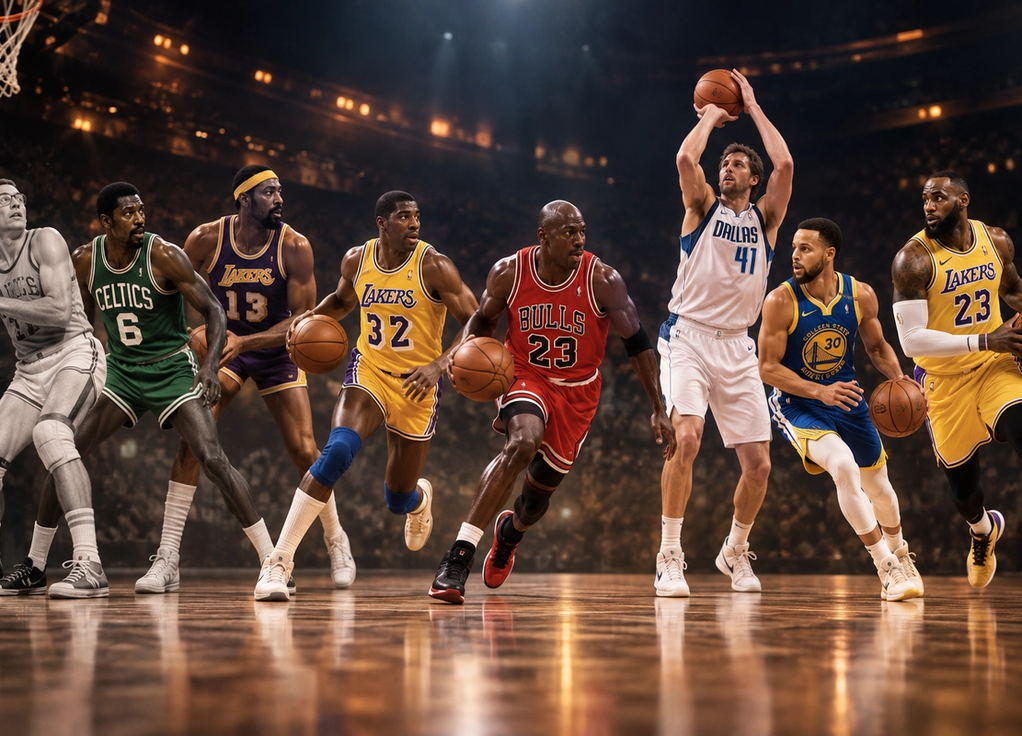
Mikan showed the power of size. Russell elevated defense. Chamberlain demonstrated unprecedented physical dominance. Magic challenged positional conventions. Jordan expanded the meaning of superstardom. Nowitzki stretched big men toward the perimeter. Curry expanded shooting range, while LeBron became one of the clearest examples of positionless basketball.
Their greatest legacy is not simply what they accomplished.
It is that basketball after them looked a little different from basketball before them.