How Modern Quarterbacks Actually Read a Defense
Rohan Pierce
September 19, 2026
Watching an elite quarterback can make playing the position look surprisingly simple. He walks to the line, looks around for a few seconds, calls something to his teammates, receives the snap, and throws the ball to an open receiver.
What viewers do not see is the enormous amount of information being processed during those few seconds.
Modern quarterbacks are not simply looking for an open player. They are identifying defensive personnel, studying where defenders are positioned, anticipating pressure, recognizing coverage structures, and comparing all of that information with the play their offense has called.
And the process does not stop when the ball is snapped.
A defense can deliberately show one thing before the snap and play something completely different afterward. Quarterbacks therefore have to read football twice: once before the play begins and again while it is happening.
The first read happens before the snap
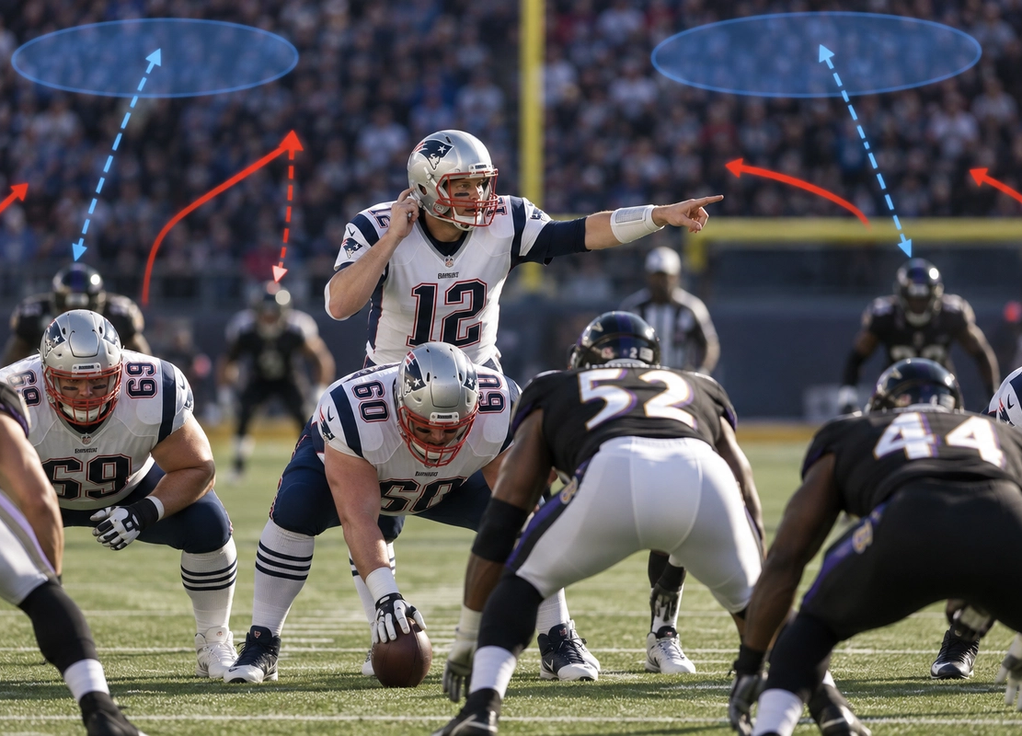
As the offense approaches the line of scrimmage, the quarterback begins collecting clues.
One of the first questions is simple: where are the defenders?
The quarterback may look at how many defenders are close to the line of scrimmage, where the linebackers are positioned, how far cornerbacks are standing from receivers, and where the safeties are located.
Safeties are particularly useful because their positioning can provide clues about the overall coverage.
A single deep safety might suggest one family of coverages. Two deeper safeties can suggest another. But quarterbacks cannot simply assume that the initial picture is accurate because defenses intentionally disguise their intentions.
The quarterback is building a hypothesis rather than discovering a guaranteed answer.
Quarterbacks look for man or zone coverage
One of the biggest questions is whether the defense appears to be playing man-to-man or zone coverage.
In man coverage, defenders are primarily responsible for particular offensive players. In zone coverage, defenders generally protect areas of the field and react to players entering those areas.
Quarterbacks use several clues to distinguish between them.
Motion is particularly useful.
An offense might send a receiver from one side of the formation to the other before the snap. If a defender follows him across the field, that can suggest man coverage. If defenders remain in their original areas and adjust responsibilities differently, zone coverage becomes more likely.
Nothing is automatic, though. Modern defenses know quarterbacks are looking for these clues and can deliberately disguise their coverage.
Football becomes a game of information and misinformation.
The safeties reveal a lot
Quarterbacks often pay close attention to the deepest defenders.
Imagine two safeties positioned deep before the snap. The quarterback may initially expect a coverage structure with two deep defenders.
Then the ball is snapped.
One safety suddenly moves toward the middle while the other attacks a shorter area. The defense has changed the picture.
Elite quarterbacks recognize these rotations quickly.
This matters because many offensive plays contain different options depending on the coverage. A receiver running toward one area might become the preferred target against one structure but a poor option against another.
The quarterback is not simply thinking, “Who is open?”
He is often thinking, “What coverage is this becoming, and which part of my play is designed to attack it?”
Pressure changes the entire calculation
Coverage is only half the problem.
Quarterbacks also need to understand who might rush them.
Normally, offensive linemen are responsible for blocking the defense’s pass rushers. But defenses can bring additional players on blitzes, creating situations where the offense may not have enough blockers for everyone.
Before the snap, quarterbacks frequently identify potential pressure.
A linebacker standing unusually close to the line might be preparing to rush. A defensive back moving toward the formation could signal pressure from the outside.
The quarterback may respond by changing the protection, communicating with the offensive line, adjusting a receiver’s route, or preparing to throw quickly.
Sometimes the most important defender is not the person being blocked.
It is the defender nobody can block.
Quarterbacks read defenders, not just receivers
After the snap, a quarterback’s eyes often focus on specific defenders.
Suppose an offensive play gives the quarterback two possible receivers in the same area. One defender may effectively determine which receiver gets the football.
If that defender moves toward the shorter route, the quarterback throws behind him to the deeper receiver. If the defender drops deeper, the quarterback takes the shorter completion.
The quarterback has effectively turned one defender into the decision-maker.
This concept appears throughout modern offensive football.
Instead of trying to understand all 11 defenders simultaneously, play designs often allow quarterbacks to focus on a smaller number of “key” defenders whose movements reveal where the ball should go.
That makes an impossibly complicated problem more manageable.
Progressions provide an order for the decision
Quarterbacks usually do not look randomly around the field hoping someone becomes open.
Passing plays often give them a progression.
Depending on the concept and coverage, the quarterback may begin with one receiver, move to a second option, then a third, and finally check the ball down to a shorter target if nothing else is available.
The progression gives structure to the decision-making process.
But quarterbacks cannot spend several seconds carefully examining every receiver. NFL pass rushers arrive far too quickly.
The best quarterbacks move through their reads rapidly.
They may reject one option almost instantly because the defense’s positioning tells them it will not work. That allows them to reach the second or third option before the receiver even appears completely open.
Anticipation is therefore just as important as vision.
Throwing before a receiver looks open
One of the biggest differences between casual football and elite quarterback play is anticipation.
On television, a viewer may see a receiver become open and wonder why the quarterback did not throw to him.
The problem is timing.
By the time a receiver is visibly open, it may already be too late.
NFL quarterbacks often need to release the football while the receiver is still making his break. The ball travels toward an area where the quarterback expects the receiver to arrive.
That requires extraordinary coordination.
The quarterback needs to understand the route, the receiver’s timing, the defensive coverage, and how quickly the defender can recover.
This is why quarterbacks and receivers spend so much time practicing together. They are developing shared expectations about where and when the football should arrive.
Defenses are constantly trying to lie
Modern defensive coordinators understand everything quarterbacks are attempting to read.
So they try to manipulate those reads.
A defense might position two safeties deep and rotate into a single-safety structure after the snap. A linebacker might appear ready to blitz and then retreat into coverage. Another defender who looked harmless may suddenly rush the quarterback.
Cornerbacks can disguise whether they are playing man or zone.
The objective is hesitation.
If a defense can make the quarterback spend even an extra fraction of a second processing what happened, the pass rush gets closer.
This is why experienced quarterbacks can appear dramatically faster than inexperienced ones even when their physical movements are similar.
They recognize patterns sooner.
Film study makes fast decisions possible
Quarterbacks do not learn all of this during the game.
Much of the work happens during the week.
They study film to identify defensive tendencies. They learn how opponents respond to certain formations, which players commonly blitz, how safeties rotate, and what coverages appear in particular situations.
Imagine discovering that a defense frequently uses a certain pressure on third-and-long.
When the quarterback sees the same alignment during the game, he already has useful information.
He still has to confirm what happens after the snap, but he is not starting from zero.
This preparation explains why quarterbacking is often described as both physical and mental. Arm strength matters. Accuracy matters. Mobility matters.
But processing speed can determine whether any of those abilities have time to matter.
The best quarterbacks make complexity look invisible
A modern quarterback may have only a few seconds between receiving the snap and being hit by a defender.
Within that tiny window, he has to confirm the coverage, recognize pressure, track defensive movement, move through his progression, anticipate where a receiver will be, and deliver an accurate football.
Elite quarterbacks make this process look almost boring.
Snap. Look. Throw. Completion.
That simplicity is deceptive.
The real skill is reducing an enormous amount of information into one correct decision before the defense can disrupt the play.
Once you understand that, watching quarterback play becomes completely different. Instead of only following where the football goes, you begin watching what the quarterback sees—and why he decides to send the ball there.