How Modern Basketball Training Has Evolved (From Then to Now)
Rohan Pierce
September 19, 2026
Basketball players have always trained hard. What has changed dramatically is what “training hard” actually means.
For much of basketball history, improvement was relatively straightforward: practice the fundamentals, run until you are in shape, lift some weights, play as much basketball as possible, and repeat. Those methods produced extraordinary athletes, but training was often based on coaching tradition and personal experience rather than detailed information about how an individual player’s body was responding.
Modern basketball operates differently. Strength coaches, nutritionists, physical therapists, sports scientists, shooting specialists, and performance analysts can all contribute to a player’s development. Training is increasingly individualized, measurable, and connected to what actually happens during games.
The result is not necessarily that today’s players work harder than previous generations. They simply have access to far more information about how to work.
Early basketball training focused on fundamentals
For decades, basketball practice centered heavily on repetition.
Players spent enormous amounts of time shooting, dribbling, passing, running drills, practicing defensive movements, and playing against teammates. Coaches emphasized conditioning because players needed enough stamina to maintain their performance throughout a game.
The philosophy was often simple: the more repetitions a player completed, the better prepared that player would become.
There is still plenty of value in that approach. No amount of technology replaces thousands of properly performed shots or years spent developing ball-handling ability.
But older training systems were generally less individualized. Two players on the same team might complete similar conditioning programs despite having completely different bodies, workloads, injury histories, and roles.
Recovery also received less attention. Fatigue was frequently treated as something athletes were expected to overcome rather than something that could be measured and managed.
Strength training became much more sophisticated
Basketball players have not always trained in the weight room the way modern athletes do.
At various points in sports history, some coaches worried that excessive weightlifting could make basketball players too bulky or reduce their flexibility. Over time, strength and conditioning became a much more important part of professional preparation.
Modern programs are not simply designed to make players bigger.
Basketball requires acceleration, jumping ability, balance, coordination, lateral movement, and the ability to absorb physical contact. Strength programs are therefore often built around improving athletic performance rather than maximizing how much weight someone can lift.
Different players also require different approaches. A center who regularly battles around the basket may have different physical demands from a smaller guard who repeatedly changes direction at high speed.
Strength training has consequently become another individualized part of player development rather than a generic addition to basketball practice.
Technology made performance measurable
One of the biggest changes in modern training is the amount of information available.
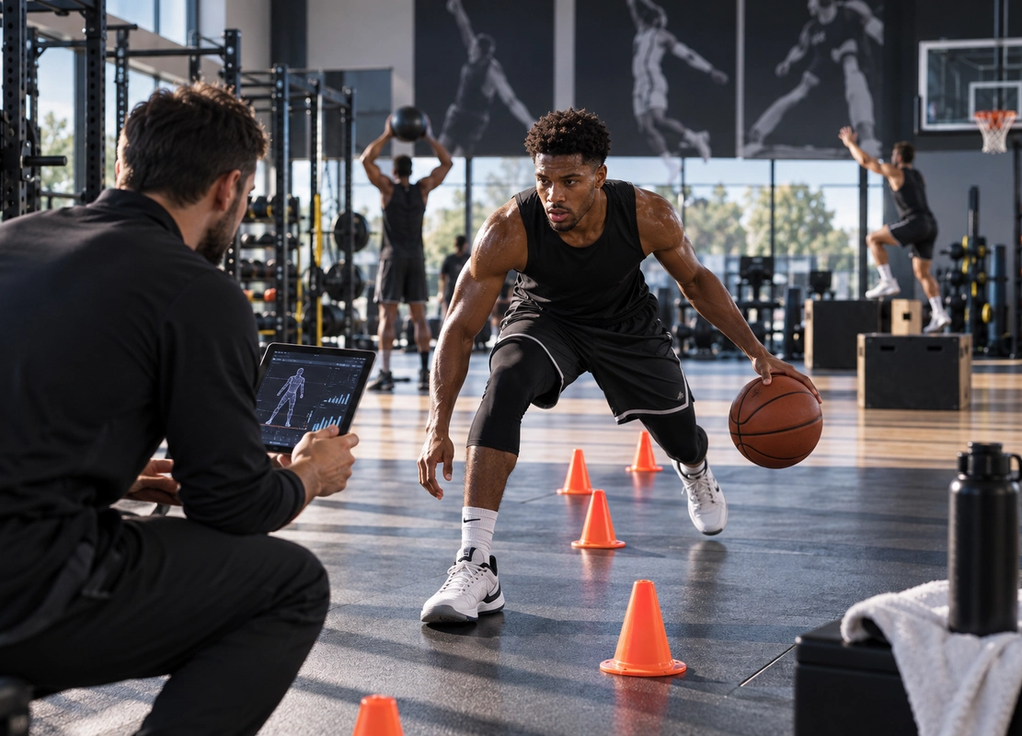
Teams can use tracking systems, video analysis, force plates, wearable technology, and other performance tools to understand how players move and how much physical stress they experience.
Instead of simply saying that an athlete “looks tired,” performance staff can examine multiple indicators of workload and recovery.
Video has transformed skill development too. Coaches can break down a player’s shooting mechanics, foot placement, defensive positioning, or decision-making in remarkable detail. A small movement that might be difficult to notice during a live practice can be repeatedly reviewed on screen.
Analytics can also help determine which skills deserve the most attention.
If game data shows that a player is particularly effective from one area of the court but inefficient from another, coaches can design training around those patterns.
Practice becomes less about repetition for its own sake and more about purposeful repetition.
Shooting practice has adapted to the modern game
Perhaps nowhere is basketball’s evolution more visible than in shooting.
Previous generations certainly produced exceptional shooters, but modern offenses place much greater emphasis on three-point range, spacing, and efficient shot selection. Players are consequently expected to practice shots that resemble the opportunities they will receive during games.
That can include catch-and-shoot threes, shots after rapid movement, pull-up jumpers, corner threes, and attempts from well beyond the traditional three-point line.
The speed of the drill matters as well.
Making an uncontested shot while standing comfortably in an empty gym is different from catching the ball after sprinting around a screen and shooting before a defender arrives.
Modern skill trainers therefore often try to reproduce game conditions. Footwork, timing, fatigue, defensive pressure, and decision-making can all become part of shooting practice.
The goal is not simply to make shots in training. It is to develop shots that remain effective during competition.
Recovery became part of training
One of the most significant philosophical changes is the treatment of recovery.
Rest was once easy to interpret as time when an athlete was not training. Today, recovery is increasingly viewed as part of the training process itself.
Professional basketball seasons place enormous stress on the body. Players repeatedly sprint, jump, change direction, collide with opponents, travel between cities, and compete on limited rest.
Adding maximum-intensity workouts every day would not necessarily make them better. It could simply leave them exhausted or increase injury risk.
Modern teams therefore pay much closer attention to sleep, hydration, mobility, nutrition, treatment, and workload management.
Training intensity can also change throughout the season. A player may train very differently during the offseason than during a stretch containing several games in a short period.
The objective is not to do as much work as physically possible. It is to apply enough stress to create improvement while allowing the body to recover from that stress.
Nutrition became more personalized
Food has always mattered to athletes, but modern sports nutrition is far more sophisticated than simply telling players to eat well.
Professional players can work with specialists who consider their body composition, energy demands, training schedule, recovery needs, and individual goals.
A player trying to gain strength may require a different nutritional strategy from someone focused on maintaining weight during a demanding season. What an athlete eats before a game may also differ from what is useful afterward.
Hydration receives similar attention.
Even relatively small changes in physical condition can matter when competition occurs at the highest level. Modern organizations therefore increasingly treat nutrition as another performance variable rather than something completely separate from basketball.
Players now train their decisions as well as their bodies
Modern basketball training is also increasingly cognitive.
The game has become extremely fast, and elite players must process information almost instantly. A ball handler coming off a screen might need to identify the defender’s coverage, locate teammates, anticipate a rotation, and decide whether to pass, shoot, or drive within seconds.
That ability can be trained.
Film study allows players to recognize recurring situations before encountering them in games. Practice drills can introduce defenders and multiple options rather than asking players to repeat a predetermined movement.
The difference is important. A player may know how to make a difficult pass, but the real skill is recognizing exactly when that pass should be attempted.
Modern development therefore focuses not only on what players can physically do but also on how quickly they can choose the correct action.
Individualized training has replaced the one-size-fits-all approach
Perhaps the biggest evolution is personalization.
A veteran center, an explosive young guard, and a three-point specialist should not necessarily follow identical training programs. Their bodies are different, their responsibilities are different, and the skills determining their success are different.
Modern basketball increasingly recognizes that.
Players can have individualized strength programs, shooting routines, recovery plans, nutritional strategies, and development goals. Coaches can use performance data to adjust those programs as circumstances change.
This does not mean old-school basketball training has disappeared. Players still run. They still lift weights. They still practice free throws, dribble through drills, watch film, and spend countless hours repeating fundamentals.
What has changed is the precision surrounding that work.
The evolution of basketball training is therefore not really a story about technology replacing traditional practice. It is about using better information to decide what to practice, how intensely to practice it, and when the body needs time to recover.
The fundamentals remain remarkably familiar. The science around them has changed almost completely.